Adaptogens and the HPA Axis: A Clinical Guide to Mechanisms, Safety, and Dosing
Discernment Over Enthusiasm
Chronic stress has become one of the defining health crises of our era. The American Psychological Association reports that a majority of Americans experience stress at levels that affect their physical health — and the downstream consequences are profound: disrupted sleep, hormonal imbalance, immune suppression, cardiovascular strain, and accelerated aging. In the search for root-cause solutions, a growing body of clinical research is pointing toward a category of plants that have been used for thousands of years across Ayurveda, Traditional Chinese Medicine, and other healing traditions: adaptogenic herbs.
These are not miracle cures. But they are, increasingly, evidence-supported tools — and for the Christ-centered integrative health community, they represent something even more meaningful: a glimpse into God's provision woven into the fabric of creation itself.
"He makes grass grow for the cattle, and plants for people to cultivate — bringing forth food from the earth." — Psalm 104:14
This is a clinical guide. Rather than a broad survey of what adaptogens are and everywhere they might help, this article goes deep on the part that matters most for practitioners and informed patients: how these herbs act on the HPA axis at a mechanistic level, and how to use them safely — evidence quality, dosing ranges, contraindications, and drug interactions. If you are looking for a wider overview of adaptogens for brain, immune, and longevity support, see our companion article, God’s Pharmacy: The Science of Adaptogens for Stress, Clarity & Resilience. Here, we focus on the science of the stress-response system itself and the practical, safety-first details of putting adaptogens to work.
What Is an Adaptogen — and What Is the HPA Axis?
The term "adaptogen" was coined in 1947 by Soviet pharmacologist Nikolai Lazarev to describe substances that help the body adapt to physical, chemical, and biological stressors. To qualify as a true adaptogen, a plant compound must meet three criteria: it must be non-toxic at normal doses, it must produce a nonspecific response that increases resistance to a broad range of stressors, and it must normalize physiological function regardless of the direction of the stressor.
At the center of the stress-response system is the HPA axis — the hypothalamic-pituitary-adrenal axis. Think of it as a three-step communication cascade:
- The hypothalamus detects a stressor and releases corticotropin-releasing hormone (CRH)
- The pituitary gland responds by releasing adrenocorticotropic hormone (ACTH)
- The adrenal cortex produces cortisol — the body's primary stress hormone
In acute situations, this system is life-saving. But under chronic stress, the HPA axis can become dysregulated — producing too much cortisol, losing its natural daily rhythm, or becoming resistant to its own feedback signals. The result is a cascade of downstream effects: disrupted sleep, impaired immunity, blood sugar dysregulation, hormonal imbalance, and accelerated cellular aging.
Adaptogenic herbs are believed to work, in part, by modulating this HPA axis — helping the body maintain balance rather than swinging into chronic overdrive.
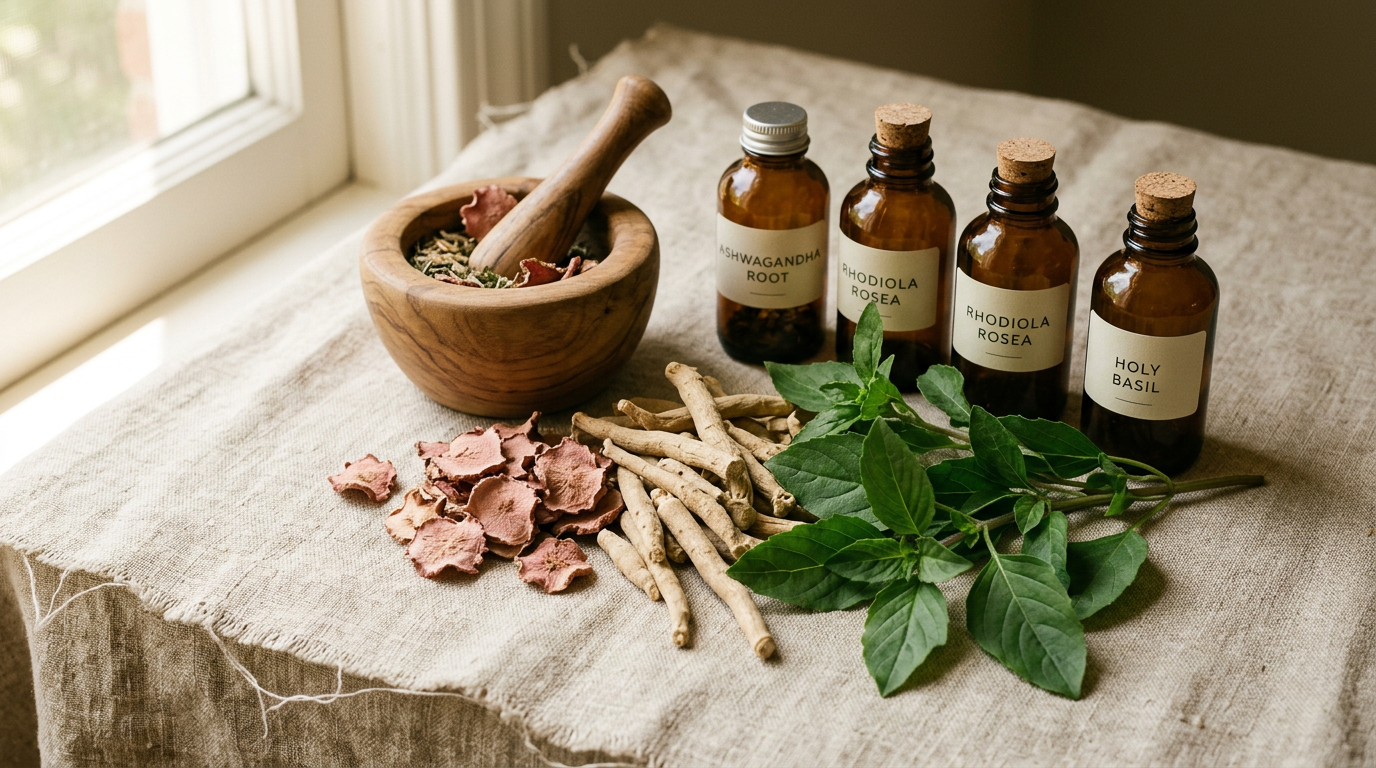
Ashwagandha: The Most Clinically Supported Adaptogen
Of all the adaptogens studied in modern clinical research, ashwagandha (Withania somnifera) has the strongest and most consistent human evidence. A meta-analysis of nine randomized controlled trials involving 558 participants found significant improvements in perceived stress and anxiety, along with measurable reductions in serum cortisol. A larger analysis of 1,002 participants confirmed these findings.
The key active compounds — withanolides — appear to modulate glucocorticoid receptor sensitivity, support GABA-ergic signaling, and reduce inflammatory cytokines that amplify the stress response. Importantly, ashwagandha also shows promise for:
- Sleep quality: Multiple trials report improved sleep onset, duration, and subjective quality
- Cognitive performance: Improvements in memory, attention, and multitasking under stress
- Physical endurance: Enhanced VO2 max and recovery in athletic populations
- Thyroid support: Some evidence for improved T3/T4 levels in subclinical hypothyroidism
A critical practical note: not all ashwagandha products are equal. Standardized extracts like KSM-66 (a full-spectrum root extract) and Sensoril are the preparations used in most clinical trials. Raw powder or unstandardized extracts cannot be assumed to deliver equivalent results. Typical research doses range from 300–600 mg daily for 6–12 weeks.
For those navigating chronic stress, sleep disruption, or HPA axis dysregulation, the Genesis World Health platform's AI Agent Council — which includes dedicated Stress & Adrenal, Clinical Medicine, and Nutraceuticals specialists — can help you evaluate whether ashwagandha fits your specific health profile and how to integrate it safely alongside any existing care.
Rhodiola Rosea: The Fatigue-Fighter
Rhodiola rosea has a long history of use in Scandinavian and Russian traditional medicine, particularly for mental fatigue, physical endurance, and resilience under demanding conditions. Modern research confirms its most consistent benefit: reducing fatigue under stress.
In a study of 80 mildly anxious adults, 200 mg twice daily for 14 days improved self-reported stress, anxiety, and mood. Other trials have found improvements in attention, mental performance, and burnout symptoms in healthcare workers and students under high cognitive load.
However, the evidence for rhodiola is more mixed than ashwagandha. Cortisol findings are inconsistent — some studies show improved cortisol-awakening response, while others find no significant change. Older systematic reviews have also flagged methodological limitations including small sample sizes and inadequate blinding.
The most honest summary: rhodiola is most promising for fatigue-type stress — the kind that comes from sustained mental effort, demanding work schedules, or physical training — rather than as a broad cortisol-lowering agent. Typical research doses range from 200–400 mg daily of a standardized extract (3% rosavins, 1% salidroside).
Holy Basil (Tulsi): Ancient Wisdom, Modern Evidence
Holy basil (Ocimum tenuiflorum), known as Tulsi in Ayurvedic tradition, holds a revered place in Indian healing culture — and increasingly, in clinical research. A 2022 randomized, double-blind, placebo-controlled trial of 100 adults found that 125 mg twice daily for eight weeks produced:
- Lower perceived stress scores compared to placebo
- Reduced hair cortisol — a marker of chronic cortisol exposure over weeks
- Buffered acute stress response — lower salivary cortisol and blood pressure during a stress test
- Improved sleep quality on subjective measures
A smaller study also found improvements in reaction time and cognitive accuracy. While these findings are promising, the evidence base is still developing — and holy basil requires caution in those with diabetes (it may lower blood glucose), those on anticoagulants, and those who are pregnant or breastfeeding.
For those drawn to Ayurvedic healing traditions, Genesis World Health's integrative approach honors the wisdom of these ancient systems while helping you navigate them safely. The platform's Personalized Care Plans can incorporate botanical protocols alongside conventional care — ensuring nothing falls through the cracks.
Eleuthero and Schisandra: Traditional Use Ahead of Clinical Certainty
Eleuthero (Eleutherococcus senticosus), sometimes called Siberian ginseng, has a long history of use in Russian and Chinese medicine for fatigue and resilience. However, a randomized trial of 144 participants found that adding eleuthero to stress-management training produced negligible additional benefit for fatigue, cortisol, or cognitive performance. Another athletic study suggested eleuthero may actually increase stress hormone indices under certain conditions — a finding that complicates the simple "adaptogen = cortisol reducer" narrative.
Schisandra (Schisandra chinensis) is a five-flavor berry used in Traditional Chinese Medicine for endurance, liver support, and mental clarity. A 12-week trial found improvements in muscle strength and resting lactate in post-menopausal women, and combination formulas including schisandra have shown cognitive benefits — but stand-alone stress and cortisol evidence remains limited.
The honest clinical picture: both eleuthero and schisandra have meaningful traditional use and plausible mechanisms, but they need stronger stand-alone human trials before specific dosing recommendations for HPA axis support can be made with confidence.
How Adaptogens Work: The Biological Mechanisms
Beyond cortisol modulation, researchers are investigating several biological pathways through which adaptogenic compounds may support stress resilience:
- HPA-axis feedback regulation: Modulating glucocorticoid receptor sensitivity and stress-hormone release patterns
- AMPK activation: An energy-sensing pathway involved in cellular energy balance and metabolic resilience
- Nrf2 pathway: A master regulator of antioxidant gene expression that protects cells from oxidative stress
- Heat-shock proteins: Cellular chaperones that protect proteins during stress — schisandrin B has been associated with this pathway
- Mitochondrial support: Protecting cellular energy production from stress-induced oxidative damage
It's important to note that much of this mechanistic evidence comes from laboratory and animal studies. These pathways offer scientifically plausible explanations for adaptogen effects — but they do not prove that taking an herb will "repair mitochondria" or "normalize the HPA axis" in every person. Human clinical evidence remains the gold standard, and it varies significantly by herb and preparation.
A Faith-Centered Perspective: God's Provision in the Plant Kingdom
For the Christ-centered integrative health community, adaptogenic herbs carry a deeper significance than their pharmacological profiles alone. Scripture consistently points to the plant kingdom as part of God's intentional provision for human flourishing:
"The fruit thereof shall be for meat, and the leaf thereof for medicine." — Ezekiel 47:12
The extraordinary complexity of adaptogenic compounds — withanolides that modulate glucocorticoid receptors, rosavins that influence serotonin and dopamine transport, eugenol in holy basil that modulates inflammatory pathways — reflects a level of biochemical sophistication that speaks to intentional design. These are not random chemical accidents. They are, in the language of Psalm 104, plants that God caused to grow for the benefit of His people.
At the same time, a faith-centered approach to adaptogens is a discerning one. Wise stewardship means:
- Prioritizing foundations first: Sleep, prayer, community, movement, and nourishing food before any supplement
- Seeking qualified guidance: Consulting a clinician before adding herbs, especially with existing medications or conditions
- Choosing evidence-matched preparations: Standardized extracts that match what was studied in clinical trials
- Recognizing limits: Adaptogens support resilience — they do not replace mental health care, counseling, or prescribed treatment
"Cast all your anxiety on him because he cares for you." — 1 Peter 5:7
The deepest adaptogen is not found in a capsule. It is found in the peace that surpasses understanding — the kind that comes from anchoring your identity and security in Christ. Botanical support can be a wise tool within that larger framework, but it is never the foundation.
Safety, Contraindications, and Practical Guidance
Adaptogenic herbs are generally well-tolerated at research doses, but they are not without risk — particularly for those with specific health conditions or on medications. Key safety considerations include:
- Ashwagandha: Avoid during pregnancy and breastfeeding; caution with thyroid disorders, autoimmune conditions, hormone-sensitive cancers, and medications affecting blood sugar, blood pressure, thyroid, or sedation. Rare liver injury has been reported.
- Rhodiola: May cause dizziness, headache, or insomnia; an interaction with losartan has been reported; insufficient safety data for pregnancy.
- Holy basil: May lower blood glucose and inhibit platelet aggregation; caution with diabetes medications, anticoagulants, and thyroid treatment; avoid during pregnancy.
- Eleuthero and Schisandra: Limited safety data; consult a clinician before use with any chronic condition or medication.
Dietary supplements are not evaluated for safety and effectiveness before marketing in the same way as pharmaceutical drugs. Product identity, purity, and extraction method can vary significantly between brands. Always choose products that have been third-party tested for purity and potency.
The Genesis World Health platform's Personalized Product Recommendations feature can help you navigate the supplement landscape — identifying high-quality, research-aligned products that match your specific health goals and avoiding the confusion of an unregulated market.
The 2026 Research Landscape: What's New
The 2025–2026 literature has added important syntheses of adaptogen biology, HPA-axis signaling, AMPK, Nrf2, and mitochondrial mechanisms. A 2026 randomized study reported benefits from both ashwagandha alone and a multi-herb formula containing rhodiola, holy basil, and schisandra — though combination results cannot establish the independent contribution of each ingredient. A 2025 rhodiola meta-analysis strengthened evidence for physical endurance performance.
The clearest 2026 conclusion: standardized ashwagandha remains the best-supported adaptogen for stress and cortisol, holy basil is promising and growing in evidence, rhodiola is most useful for fatigue-type stress, and eleuthero and schisandra need stronger stand-alone trials. The field is advancing — but it rewards discernment over enthusiasm.
🌿 Build Your Personalized Stress-Resilience Protocol
Navigating adaptogens, cortisol balance, and HPA axis support is complex — and deeply personal. Genesis World Health's AI Agent Council brings together Stress & Adrenal, Nutraceuticals, and Clinical Medicine specialists to help you build a root-cause protocol tailored to your unique biology. Explore Personalized Product Recommendations for research-aligned supplement guidance, and use the Health Assessment tool to identify your specific stress-resilience gaps.
A Personal Note from Genesis World Health
The information shared in this article is for educational purposes and reflects our commitment to integrating faith, science, and whole-person wellness. It is not a substitute for professional medical advice, diagnosis, or treatment. Every person’s health journey is unique — fearfully and wonderfully made — and what works for one may not be right for another.
We encourage you to consult with functional medicine physicians, endocrinologists, clinical pharmacists, and your primary care provider when making significant changes to your approach to managing chronic stress or adding adaptogenic herbs to your regimen. Our prayer is that this knowledge empowers you to make informed, faith-guided decisions for the body God has entrusted to you.
Sources & References
- Pratte MA, Nanavati KB, Young V, Morley CP. An alternative treatment for anxiety: a systematic review of human trial results reported for the Ayurvedic herb ashwagandha (Withania somnifera). J Altern Complement Med. 2014;20(12):901-908.
- Chandrasekhar K, Kapoor J, Anishetty S. A prospective, randomized double-blind, placebo-controlled study of safety and efficacy of a high-concentration full-spectrum extract of ashwagandha root in reducing stress and anxiety in adults. Indian J Psychol Med. 2012;34(3):255-262.
- Cropley M, Banks AP, Boyle J. The effects of Rhodiola rosea L. extract on anxiety, stress, cognition and other mood symptoms. Phytother Res. 2015;29(12):1934-1939.
- Jamshidi N, Cohen MM. The clinical efficacy and safety of Tulsi in humans: a systematic review of the literature. Evid Based Complement Alternat Med. 2017;2017:9217567.
- Panossian A, Wikman G. Effects of adaptogens on the central nervous system and the molecular mechanisms associated with their stress-protective activity. Pharmaceuticals (Basel). 2010;3(1):188-224.
- Speers AB, Cabey KA, Soumyanath A, Wright KM. Effects of Withania somnifera (ashwagandha) on stress and the stress-related neuropsychiatric disorders anxiety, depression, and insomnia. Curr Neuropharmacol. 2021;19(9):1468-1495.