Ayurveda vs. Peptide Therapeutics: Two Paths to Cellular Renewal
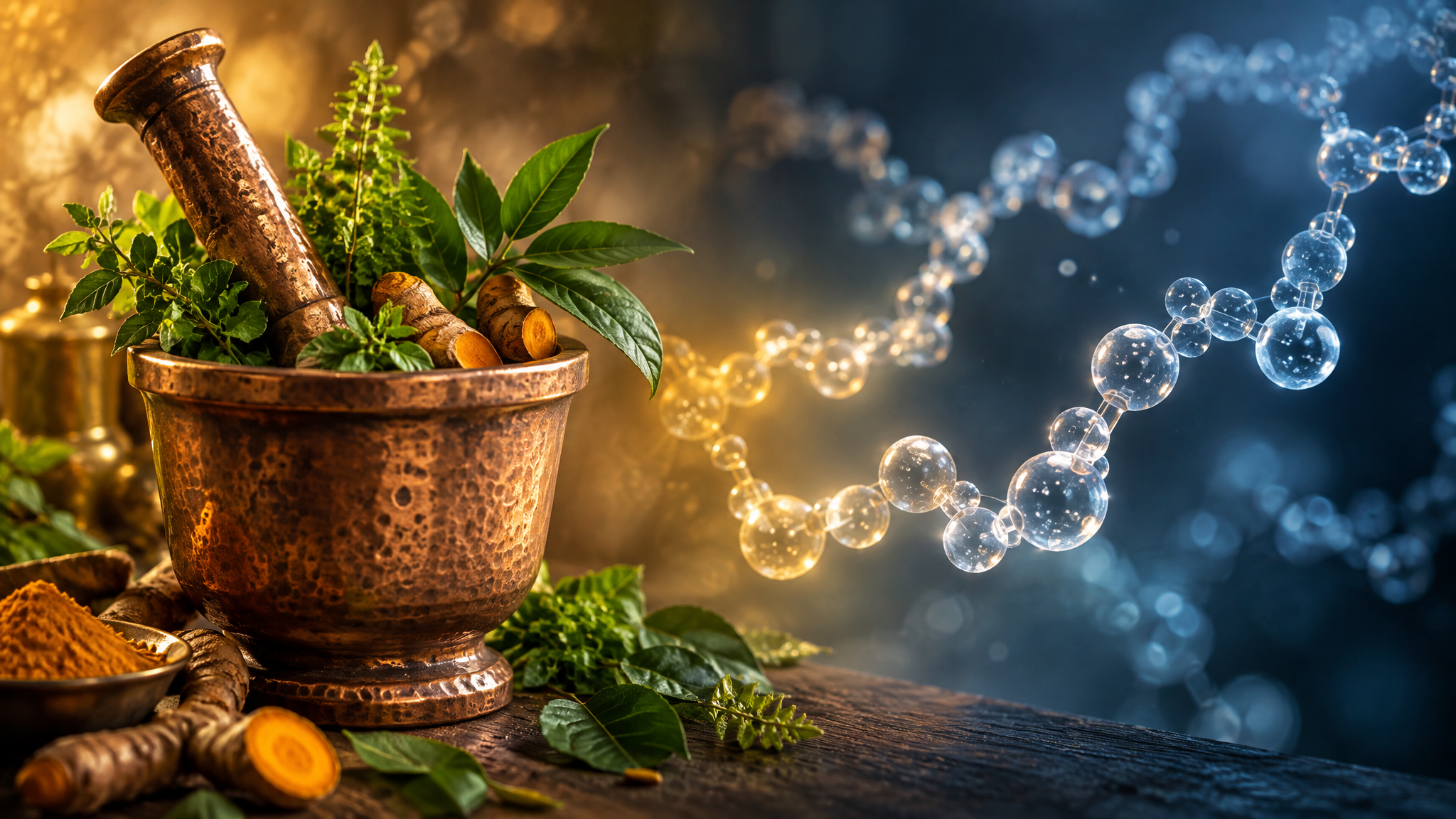
Two Paths, One Divine Design for Renewal
When people search "Ayurveda vs. Peptide Therapeutics," they are usually looking for a verdict: which one works better, which one is safer, which one is worth the investment. Genesis World Health's Ayurveda and Peptide Therapeutics Digital Health Agents offer a different starting point. Both agents share a conviction that the either/or framing misses the deeper question. The real question is not which system wins. It is how two profoundly different expressions of the same divine design for cellular renewal can work together to restore the whole person.
Ayurveda has been optimizing cellular rejuvenation for more than 5,000 years through its rasayana tradition, a Sanskrit word meaning "path of essence." Peptide therapeutics, by contrast, works at the molecular level, targeting specific receptor pathways to signal tissue repair and regeneration. One operates through constitutional balance and whole-system harmony. The other operates through precise biochemical signaling. Together, they address renewal at two scales that neither can fully reach alone.
This post explores what each approach genuinely offers, where they agree, where they differ, and how the integrative lens of Genesis World Health brings them into a coherent whole-person framework rooted in the conviction that God designed the body with extraordinary capacity for renewal.
What Ayurveda Offers
Ayurveda's approach to cellular renewal centers on the concept of rasayana, a category of herbs, foods, and practices specifically designed to promote longevity, vitality, and the regeneration of bodily tissues. The word itself points to the goal: restoring the essence of life at every level of the body.
Modern research has begun to map the molecular mechanisms behind rasayana's effects. A 2026 multi-omics review published in PMC identified that rasayana formulations modulate key longevity-associated signaling pathways including FOXO, SIRT1, AMPK, Akt-mTOR, and the Keap1-Nrf2 antioxidant pathway. These are not peripheral effects. They are the same pathways that modern longevity science has identified as central to aging, cellular senescence, and metabolic resilience.
Ashwagandha (Withania somnifera), one of Ayurveda's most studied rasayana herbs, has demonstrated the ability to decelerate cellular senescence in human fibroblasts, enhance proteasomal activity to clear toxic protein aggregates, and upregulate telomerase activity to support cellular longevity. A 2026 study on Amalaki Rasayana showed that midlife-initiated supplementation preserved heart rate variability, reduced myocardial fibrosis, and maintained neuronal integrity in aging subjects.
Beyond individual herbs, Ayurveda's strength lies in its constitutional framework. The concept of Prakriti, an individual's inherent psycho-physiological constitution, provides a personalized lens for understanding why the same herb or practice produces different results in different people. A 2026 review in PMC on Ayurgenomics found that Prakriti types correspond to distinct gene expression patterns, immune response profiles, and metabolic pathways, suggesting that Ayurveda's ancient personalization framework anticipates what modern precision medicine is only beginning to formalize.
Ayurveda also addresses renewal through lifestyle practices: dinacharya (daily rhythms), seasonal eating, Panchakarma detoxification, and the cultivation of ojas, the subtle essence of vitality that Ayurveda considers the foundation of immunity and longevity. These are whole-system interventions that work over months and years, building constitutional resilience rather than targeting a single pathway.
What Peptide Therapeutics Offers
Peptide therapeutics approaches cellular renewal from the opposite direction: not through constitutional balance, but through precise molecular signaling. Peptides are short chains of amino acids that act as biological messengers, binding to specific receptors to initiate targeted cellular responses. The body already produces thousands of peptides naturally. Therapeutic peptides either mimic these endogenous signals or amplify them in specific tissues.
The regenerative potential of peptides is most clearly demonstrated in tissue repair research. BPC-157, a pentadecapeptide derived from gastric juice, has been extensively studied in preclinical models for its ability to promote angiogenesis, fibroblast migration, and tendon and ligament healing. It acts through VEGFR2, Akt-eNOS, and ERK1/2 signaling pathways, the same pathways involved in wound healing and tissue remodeling. Animal studies have shown that its physiological effects persist for weeks after administration, suggesting it acts as a biological switch that initiates self-sustaining healing cascades.
GHK-Cu (glycyl-L-histidyl-L-lysine copper complex) is one of the most clinically validated regenerative peptides. A clinical study involving 21 subjects found that a GHK-Cu gel formulation used over three months produced an average 28% increase in subdermal collagen density, with the top quartile of participants experiencing a 51% improvement. GHK-Cu works by modulating the expression of thousands of human genes, effectively resetting cells toward a younger, healthier phenotype. It stimulates collagen and elastin synthesis, reduces inflammatory markers including IL-6 and TNF-alpha, and supports stem cell activity in the skin's basal layer.
TB-500, a synthetic fragment of Thymosin beta-4, promotes cell migration, angiogenesis, and extracellular matrix remodeling. Research comparing BPC-157 and TB-500 in Achilles tendon injury models found that both peptides improved tissue architecture and extracellular matrix organization, with TB-500 showing statistically significant improvements in biomechanical load-to-failure testing.
The precision of peptide therapeutics is its defining strength. Where Ayurveda works through constitutional balance and whole-system harmony, peptides work through targeted receptor-level signaling. They can be directed at specific tissues, specific pathways, and specific stages of the healing process. This precision makes them particularly valuable for acute tissue repair, post-injury recovery, and targeted anti-aging interventions.
It is worth noting that many therapeutic peptides, including BPC-157 and TB-500, remain in preclinical or early clinical stages for most applications. The evidence base is strongest in animal models, and robust human clinical trials are still developing. This is an important distinction for anyone exploring this area, and it underscores the value of working with knowledgeable guidance rather than navigating the landscape alone.
Where They Agree
Despite their different vocabularies and timescales, Ayurveda and peptide therapeutics share a foundational conviction: the body is designed to renew itself, and the role of any healing intervention is to support that innate capacity rather than override it.
Both approaches recognize that cellular renewal is not a single event but an ongoing process. Ayurveda's rasayana tradition is built around sustained, long-term support for the body's regenerative systems. Peptide therapeutics, even in its most targeted applications, works by initiating biological cascades that the body then sustains on its own. Neither approach is about forcing the body into a state it cannot maintain. Both are about restoring conditions in which the body's own renewal mechanisms can function optimally.
Both also recognize the importance of the cellular environment. Ayurveda addresses this through diet, lifestyle, and the reduction of ama (toxic accumulation). Peptide therapeutics addresses it through anti-inflammatory signaling and the modulation of oxidative stress pathways. The Nrf2 antioxidant pathway, activated by ashwagandha in Ayurvedic research, is the same pathway that GHK-Cu modulates in peptide research. Two traditions, two vocabularies, one shared biological target.
Both approaches also honor the individuality of the healing process. Ayurveda's Prakriti framework and the emerging field of Ayurgenomics recognize that constitutional differences shape how individuals respond to interventions. Peptide therapeutics, particularly in its more advanced applications, is moving toward personalized approaches based on individual biomarkers and tissue-specific needs. The convergence is not coincidental. It reflects a shared recognition that one-size-fits-all approaches miss the complexity of the human body.
Where They Genuinely Differ
The most significant difference between Ayurveda and peptide therapeutics is timescale. Ayurveda's rasayana tradition is designed for sustained, long-term constitutional renewal. The benefits of ashwagandha, Amalaki Rasayana, and similar interventions accumulate over months and years. They build resilience, restore constitutional balance, and address the root conditions that make the body vulnerable to aging and disease. This is not a limitation. It is a feature of a system designed for lifelong health stewardship.
Peptide therapeutics, by contrast, can produce targeted effects in shorter timeframes. GHK-Cu's collagen-stimulating effects were measurable within three months. BPC-157's tissue repair effects in animal models were observed within weeks. For acute injuries, post-surgical recovery, or targeted anti-aging interventions, this precision and speed is a genuine advantage that Ayurveda's whole-system approach cannot replicate.
The two approaches also differ in their regulatory and evidence landscapes. Ayurveda has millennia of traditional use and a growing body of modern research, but standardization of formulations and large-scale clinical trials remain ongoing challenges. Peptide therapeutics has strong preclinical evidence for many agents, but human clinical data is still developing for most applications, and regulatory approval varies significantly by peptide and jurisdiction. Neither system is without its evidence gaps. Both are areas where the science is actively advancing.
Finally, Ayurveda addresses the whole person, including the mental, emotional, and spiritual dimensions of health, through its integrated framework of diet, lifestyle, herbs, and practice. Peptide therapeutics is primarily a biochemical intervention. It can support physical renewal with precision, but it does not address the constitutional, emotional, or spiritual dimensions that Ayurveda considers inseparable from physical health. This is not a criticism. It is a recognition that the two systems are operating at different levels of the whole person, and that both levels matter.
How to Bring Them Together
The reconciliation thesis here is straightforward: Ayurveda's rasayana tradition and peptide therapeutics are two expressions of the same divine design for cellular renewal, operating at different scales and timescales. Ayurveda works through whole-system constitutional balance, building the conditions in which the body's renewal mechanisms can function optimally over a lifetime. Peptide therapeutics works through precise receptor-level signaling, targeting specific tissues and pathways for accelerated repair and regeneration.
Together, they address renewal at both the macro level (constitutional balance, lifestyle, whole-system resilience) and the micro level (cellular signaling, tissue repair, molecular pathway modulation). A person recovering from a musculoskeletal injury might benefit from the targeted tissue repair support that peptide research points toward, while simultaneously building the constitutional resilience and anti-inflammatory foundation that Ayurveda's rasayana tradition provides. A person focused on healthy aging might use Ayurvedic herbs and lifestyle practices as the long-term foundation, with targeted peptide support for specific areas of concern.
This is the integrative vision that Genesis World Health is built around. The platform's 68 Digital Health Agents include both the Ayurveda agent and the Peptide Therapeutics agent, a VIP-tier resource for members who want to explore the more advanced applications of peptide science. Rather than choosing between ancient wisdom and modern molecular science, members can explore both perspectives, compare insights, and build a whole-person approach that honors the full complexity of how God designed the body to renew itself.
"He restores my soul." — Psalm 23:3
Restoration is not a single event. It is a process that operates at every level of the person, from the constitutional to the cellular, from the spiritual to the molecular. The wisdom to support that process comes from many sources. Genesis World Health exists to bring those sources together in one place, so that every member can pursue renewal with the full breadth of knowledge available to them.
Explore Both Perspectives Inside Genesis World Health
Genesis World Health's 68 Digital Health Agents include both the Ayurveda agent and the Peptide Therapeutics agent. Ask each one questions, compare perspectives, and build a whole-person renewal approach that draws from ancient wisdom and modern molecular science. The Peptide Therapeutics agent is part of the VIP tier, available to members who want to explore the most advanced applications of regenerative science.
A Personal Note from Genesis World Health
The information shared in this article is for educational purposes and reflects our commitment to integrating faith, science, and whole-person wellness. It is not a substitute for professional medical advice, diagnosis, or treatment. Every person's health journey is unique, and what works for one may not be right for another.
We encourage you to consult with Ayurvedic practitioners, integrative medicine physicians, regenerative medicine specialists, and your primary care provider when making significant changes to your approach to cellular renewal and regenerative health. Our prayer is that this knowledge empowers you to make informed, faith-guided decisions for the body God has entrusted to you.
Sources & References
- Rasayana therapy and longevity pathways (FOXO, SIRT1, AMPK, Nrf2): PMC13734886 (2026)
- Amalaki Rasayana and organ preservation in aging: PMC13217850 (2026)
- Ayurgenomics and Prakriti molecular correlates: PMC13507822 (2026)
- BPC-157 and TB-500 in musculoskeletal repair: PMC12446177 (2025)
- GHK-Cu collagen density clinical study: Aesthetic Surgery Journal (2026)
- Ashwagandha cellular senescence and longevity mechanisms: Biogerontology (2025)