Berberine in 2026: What the Science Actually Shows About This Ancient Supplement and God's Design for Metabolic Health
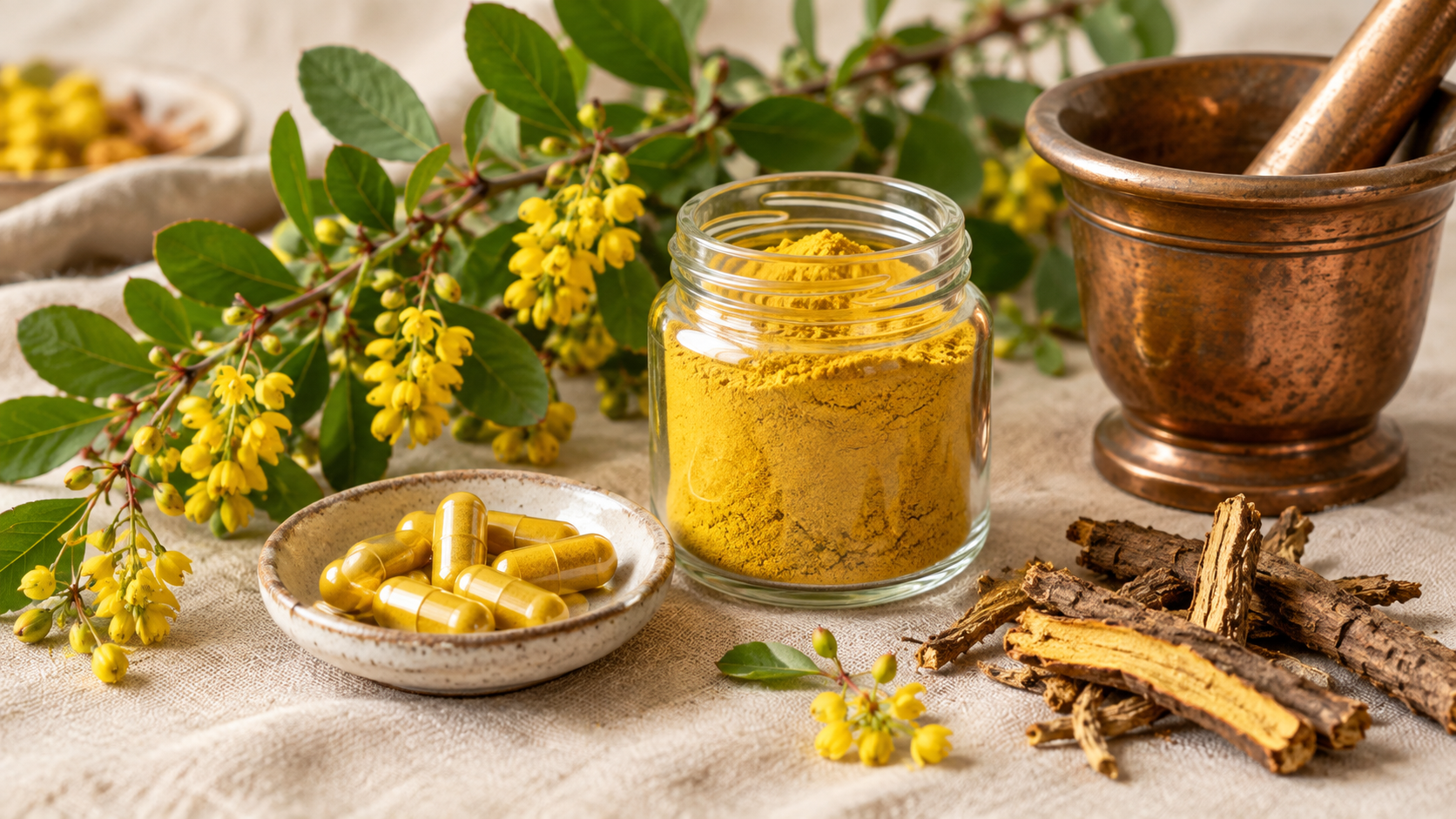
Every few years, a natural compound captures the attention of both researchers and wellness seekers alike — and in 2026, berberine has become one of the most discussed supplements in integrative medicine. Dubbed "nature's Ozempic" in popular media, berberine is a plant-derived alkaloid with a centuries-long history in Traditional Chinese Medicine and Ayurveda that is now being studied with modern clinical rigor. But what does the science actually say? And how does a Christ-centered approach to health help us navigate the difference between genuine promise and marketing hype?
The answer, as with most things in integrative medicine, is nuanced — and that nuance is worth understanding before you add anything to your daily routine.
What Is Berberine — and Where Does It Come From?
Berberine is an isoquinoline alkaloid found in several plants, including Coptis chinensis (goldthread) in Traditional Chinese Medicine and Berberis aristata (tree turmeric), known in Ayurveda as Daruharidra. These plants have been used for thousands of years to support digestion, reduce inflammation, and address metabolic imbalances — long before modern science had the tools to explain why they worked.
Today, most berberine research focuses on the isolated alkaloid rather than the whole herb. This distinction matters: a whole plant contains dozens of compounds working synergistically, while a purified supplement delivers one concentrated molecule. Both have value, but they are not interchangeable — and the research on one does not automatically apply to the other.
Berberine also has notably low oral bioavailability, meaning much of what you swallow is not absorbed into the bloodstream. Rather than making it ineffective, this may actually explain where it works best: within the gastrointestinal tract, where it can influence the gut microbiome, bile acid metabolism, and intestinal signaling before it ever reaches systemic circulation.
The Science of How Berberine Works
Modern research has identified several plausible mechanisms through which berberine may support metabolic health. Understanding these pathways helps set realistic expectations — and separates what is scientifically established from what remains theoretical.
AMPK Activation: The Cellular Energy Switch
One of berberine's most studied mechanisms is its ability to activate AMP-activated protein kinase, or AMPK — often called the body's "master metabolic switch." AMPK functions as a cellular energy sensor: when energy is low, AMPK activates pathways that increase glucose uptake, enhance fatty acid oxidation, and reduce glucose production in the liver.
This is the same general pathway influenced by metformin, the most widely prescribed diabetes medication in the world. Laboratory research confirms that berberine can activate AMPK through mitochondrial complex I inhibition. However, activating a pathway in a cell culture is not the same as producing a clinically meaningful outcome in a living person — and this distinction is critical for honest evaluation.
Berberine and the Gut Microbiome
Because berberine is poorly absorbed, the gut is likely a primary site of action. Research suggests that berberine can meaningfully alter gut microbial composition, short-chain fatty acid production, and bile acid metabolism. The landmark PREMOTE trial — a 409-participant randomized study in people with type 2 diabetes — demonstrated measurable microbiome changes with berberine supplementation over approximately 12 weeks.
Some studies have noted enrichment of Akkermansia muciniphila, a bacterium associated with gut barrier integrity and metabolic health. These findings are promising, but microbial responses vary significantly between individuals, and researchers have not yet established that increasing any one organism reliably produces a specific clinical outcome.
For those exploring gut health support, tools like the Genesis World Health AI Nutrition Specialist can help create personalized dietary protocols that work alongside supplements like berberine — addressing the broader nutritional and lifestyle factors that shape your microbiome over time.
The GLP-1 Connection — and Why "Nature's Ozempic" Misses the Mark
Perhaps the most misunderstood claim about berberine is that it functions like a GLP-1 receptor agonist — the class of drugs that includes semaglutide (Ozempic). The truth is more nuanced. Berberine may indirectly influence endogenous GLP-1 secretion through its effects on gut bacteria, bile acids, and intestinal L cells. But this is fundamentally different from a prescription GLP-1 drug, which directly activates the GLP-1 receptor through a pharmaceutical mechanism.
No head-to-head human clinical trial has established berberine as equivalent to prescription GLP-1 therapy. The "nature's Ozempic" label is a marketing slogan — not a scientific conclusion — and using it collapses distinct mechanisms, evidence standards, and expected clinical effects into a phrase that can mislead people away from treatments they genuinely need.
What the Human Evidence Actually Shows
When we look at the clinical trial data — the level of evidence that matters most for real-world decisions — berberine shows genuine but modest benefits in specific populations.
Blood Sugar and Insulin Sensitivity
The strongest evidence for berberine is in people who already have type 2 diabetes or metabolic syndrome. Across multiple randomized trials and meta-analyses, berberine supplementation has been associated with:
- Lower fasting blood glucose: Consistent reductions reported across multiple studies in diabetic populations
- Improved HbA1c: Meaningful reductions in long-term blood sugar markers
- Better insulin sensitivity: Reflected in lower fasting insulin and HOMA-IR scores
- Reduced post-meal glucose spikes: Particularly relevant for metabolic syndrome management
A frequently cited 13-week trial compared berberine (500 mg three times daily) with metformin (1,500 mg daily) and reported similar changes in some glycemic measures. However, one short study does not establish broad therapeutic equivalence — and berberine should never be used to stop or replace prescribed medication without a clinician's guidance.
Lipids and Cardiovascular Markers
Pooled human evidence generally supports reductions in triglycerides, total cholesterol, and LDL cholesterol. Some studies also report changes in inflammatory markers like C-reactive protein and interleukin-6. These are encouraging findings — but it is important to note that changing a laboratory marker is not the same as preventing a heart attack or stroke. No large, long-term human trial has established that berberine reduces cardiovascular events or mortality.
Weight and Liver Fat: A Sobering 2026 Update
A January 2026 randomized clinical trial published in JAMA Network Open provides an important corrective to weight-loss claims. The study enrolled 337 diabetes-free adults with obesity and metabolic dysfunction–associated steatotic liver disease (MASLD). Participants received 1 gram of berberine daily or placebo for six months.
The result: berberine did not significantly reduce visceral fat or liver fat compared with placebo. LDL cholesterol and high-sensitivity C-reactive protein did improve — but the neutral primary outcomes challenge the narrative that berberine is a reliable weight-loss or liver-fat treatment for people without existing metabolic disease.
This is not a reason to dismiss berberine — it is a reason to understand it accurately. Honest stewardship of our health requires honest evaluation of the tools we use.
Traditional Wisdom: TCM and Ayurveda Perspectives
Long before clinical trials, berberine-containing plants were used across healing traditions that understood the body as an integrated whole. In Traditional Chinese Medicine, Coptis chinensis (Huang Lian) has been used for centuries to address what TCM practitioners describe as "damp heat" — a pattern associated with digestive dysfunction, inflammation, and metabolic imbalance. In Ayurveda, Berberis aristata has been used to support liver function, digestion, and skin health.
These traditions deserve respectful engagement on their own terms. They were not practicing biochemistry — they were observing patterns of health and disease across generations, and their insights often preceded modern mechanistic understanding by centuries. At Genesis World Health, our platform honors both Eastern and Western healing wisdom, recognizing that God placed healing knowledge in many traditions across human history.
"The earth is the Lord's, and everything in it, the world, and all who live in it." — Psalm 24:1
The plants that produce berberine are part of God's creation — and the wisdom embedded in traditional healing systems reflects centuries of careful human observation of that creation. Modern science helps us understand why these plants work; traditional wisdom reminds us that they have been working for a very long time.
The Genesis World Health platform includes dedicated agents for both Traditional Chinese Medicine and Ayurveda, offering personalized insights that integrate ancient botanical wisdom with modern evidence — so you can explore berberine and other botanicals within the full context of your health history and constitution.
Safety, Dosing, and What to Watch For
Clinical trials commonly use 900 to 1,500 milligrams of berberine daily, divided into two or three doses taken with meals. Divided dosing helps reduce the most common side effects: gastrointestinal symptoms including diarrhea, constipation, nausea, and abdominal cramping.
These symptoms should be treated as possible adverse effects — not as evidence that the supplement is "working." Persistent or severe GI symptoms deserve clinical review.
Several important safety considerations apply:
- Drug interactions: Berberine inhibits CYP3A4, CYP2D6, CYP2C9, and P-glycoprotein — enzymes that process many prescription medications, including some anticoagulants, statins, immunosuppressants, and glucose-lowering drugs
- Additive glucose-lowering effects: Combining berberine with insulin, sulfonylureas, or metformin may produce additive effects requiring monitoring
- Pregnancy and breastfeeding: Berberine should not be used during pregnancy or breastfeeding due to concerns about neonatal bilirubin displacement
- Supplement quality variability: Unlike prescription drugs, supplements are not subject to the same premarket evaluation for potency and purity — look for products with documented identity, purity, and potency testing
The Genesis World Health Personalized Insights feature allows members to track supplements alongside other health interventions, creating a comprehensive picture that supports informed conversations with your own healthcare provider.
Berberine vs. Metformin vs. GLP-1 Therapy: An Honest Comparison
Understanding where berberine fits in the landscape of metabolic support requires honest comparison — not marketing claims.
Berberine is a plant-derived supplement with modest, variable evidence for glycemic and lipid support in people with existing metabolic dysfunction. It is not standardized like a pharmaceutical, has not been proven to reduce cardiovascular events, and should not replace prescribed treatment.
Metformin is a standardized prescription medicine with decades of clinical evidence, established cardiovascular outcome data, and a well-characterized safety profile. It is the first-line pharmacological treatment for type 2 diabetes for good reason.
GLP-1 receptor agonists (semaglutide, tirzepatide) directly activate a defined receptor through a pharmaceutical mechanism, producing drug-level effects on appetite, weight, and blood sugar that berberine cannot replicate through indirect microbiome or bile acid pathways.
The wisest integrative approach recognizes that these are different tools for different situations — and that a supplement should complement, not compete with, evidence-based medical care.
A Christ-Centered Approach to Supplement Stewardship
Scripture calls us to be good stewards of the bodies God has given us — and stewardship requires discernment. In a wellness culture saturated with bold claims and viral trends, the Christ-centered path is one of honest inquiry, humble evaluation, and wise counsel.
"The simple believe anything, but the prudent give thought to their steps." — Proverbs 14:15
Berberine is a genuinely interesting compound with real, if modest, evidence for metabolic support. It is not a miracle cure, not equivalent to prescription medication, and not appropriate for everyone. But for the right person, in the right context, with appropriate clinical oversight, it may be a valuable part of a comprehensive integrative health strategy.
The Genesis World Health Nutraceuticals and Supplements resources — including Personalized Product Recommendations — are designed to help members navigate exactly these kinds of decisions: evaluating the evidence, understanding the context, and making choices that honor both the science and the wisdom of whole-person care.
God designed the body with remarkable capacity for self-regulation and metabolic balance. Our role is to support that design with the best tools available — and to hold those tools with open hands, always willing to update our understanding as the evidence grows.
Ready to Navigate Supplements With Confidence?
Genesis World Health's Digital Nutrition Health Agent and Personalized Insights help you evaluate nutraceuticals like berberine in the context of your unique health profile. Our dedicated Traditional Chinese Medicine and Ayurveda agents bring ancient botanical wisdom to your modern wellness journey — so every supplement decision is informed, intentional, and whole-person centered.
A note from Genesis World Health: This article is for educational purposes only and does not constitute medical advice, diagnosis, or treatment. Berberine and other supplements may interact with prescription medications and are not appropriate for everyone. Always consult your own licensed healthcare provider before starting, stopping, or changing any supplement or medication regimen.
Sources & References
- Asbaghi O, et al. "Effects of berberine on glycemic indices in patients with type 2 diabetes: A systematic review and meta-analysis." Nutrition. 2020. https://doi.org/10.1016/j.nut.2020.110832
- Xie W, et al. "Berberine and its effects on gut microbiota and metabolic disorders: A review." Frontiers in Pharmacology. 2022. https://doi.org/10.3389/fphar.2022.1074785
- Zhang Y, et al. "Treatment of type 2 diabetes and dyslipidemia with the natural plant alkaloid berberine." Journal of Clinical Endocrinology & Metabolism. 2008. https://doi.org/10.1210/jc.2007-2404
- Yin J, et al. "Efficacy of berberine in patients with type 2 diabetes mellitus." Metabolism. 2008. https://doi.org/10.1016/j.metabol.2008.01.013
- Loomba R, et al. "Berberine for metabolic dysfunction-associated steatotic liver disease: A randomized clinical trial." JAMA Network Open. 2026. https://doi.org/10.1001/jamanetworkopen.2025.55027
- Xu JH, et al. "Berberine modulates gut microbiota to reduce the severity of type 2 diabetes: The PREMOTE trial." Nature Communications. 2020. https://doi.org/10.1038/s41467-020-18414-8