Kimchi's Hidden Power: The 2026 Probiotic Discovery That Removes Nanoplastics From Your Gut and God's Design for Protection
God Designed Your Gut to Fight Back
Nanoplastics are now inside every human body on earth. They have been found in the brain, the kidneys, the liver, arterial plaques, and even the placenta. Scientists estimate that the average person ingests the equivalent of a credit card's worth of plastic every week through food, water, and air. For years, the medical community had no answer for how to remove these particles once they entered the gut. A 2026 study published in Bioresource Technology by researchers at the World Institute of Kimchi (WiKim) has changed that conversation. A lactic acid bacterium found in traditional kimchi, Leuconostoc mesenteroides CBA3656, binds polystyrene nanoplastics with 87% efficiency in laboratory conditions and more than doubles their excretion in animal models. The body God designed already has remarkable defense systems. This discovery suggests that the ancient wisdom of fermented food may be one of them.
Genesis World Health's Gut Microbiome and Detoxification specialists have long emphasized that the gut is not merely a digestive organ. It is the body's primary interface with the environment, a living filter that determines what enters the bloodstream and what gets expelled. The kimchi probiotic discovery fits squarely within that framework: the right microbial allies in the gut can intercept environmental toxins before they reach your organs. This article explores what the science shows, why fermented foods matter more than ever, and how you can support your body's God-given capacity for protection and renewal.
The Nanoplastic Crisis: What Is Already Inside You
Nanoplastics are plastic particles smaller than one micrometer, often invisible to the naked eye. They enter the body through contaminated seafood, produce, drinking water, packaged foods, and even the air we breathe. Once ingested, they do not simply pass through. Research published in Nature Medicine in 2024 confirmed that nanoplastics accumulate in the brain, liver, and kidneys, with brain concentrations rising measurably between 2016 and 2024. Studies have found that individuals with dementia carry significantly higher concentrations of plastic particles in the frontal cortex than those without the condition.
The mechanisms of harm are still being studied, but the picture emerging from the research is sobering. Nanoplastics can cross the blood-brain barrier, the intestinal epithelium, and even the placental barrier. Once inside tissues, they trigger oxidative stress, disrupt energy metabolism, and impair neuroimmune integrity. In arterial plaques, their presence has been associated with elevated inflammation and higher cardiovascular risk. The particles are small enough to be taken up by immune cells, which then carry them deeper into the body.
The gut is the primary entry point. The intestinal epithelium, the mucus layer, and the gut-associated lymphoid tissue (GALT) form the first line of defense. When that defense is compromised by dysbiosis, poor diet, or chronic stress, nanoplastics gain easier access to the bloodstream. This is why the health of the gut microbiome is not a peripheral wellness concern. It is a frontline environmental defense.
The 2026 Kimchi Discovery: A Probiotic That Binds Plastic
The World Institute of Kimchi study, published in Bioresource Technology (Volume 447, 2026), identified Leuconostoc mesenteroides CBA3656 as a highly effective microbial biosorbent for polystyrene nanoplastics. The research team, led by Drs. Se Hee Lee and Tae Woong Whon, evaluated the strain's ability to bind nanoplastics across a range of pH levels, temperatures, and plastic concentrations.
Under standard laboratory conditions, the strain achieved 87% adsorption efficiency. What made the finding clinically significant was its performance under conditions designed to mimic the human gastrointestinal tract. A reference strain, Latilactobacillus sakei CBA3608, saw its adsorption efficiency collapse from 85% in standard conditions to just 3% in simulated intestinal fluid. L. mesenteroides CBA3656 maintained a robust 57% adsorption rate under the same gut-mimicking conditions. The difference lies in the bacterium's cell wall composition. Its surface contains functional groups, specifically P=O, C=O, and C-O-C bonds, that physically bind to nanoplastic particles through a process consistent with Langmuir isotherm and pseudo-first-order kinetics. The bacterium's amphiphilic nature, meaning it interacts with both water-soluble and fat-soluble compounds, gives it unusual versatility in the complex environment of the gut.
In germ-free mouse models, administration of the strain resulted in more than a twofold increase in nanoplastics detected in feces compared to control groups. The implication is significant: the probiotic does not merely bind the particles in a test tube. It facilitates their excretion from the body, potentially preventing their accumulation in organs where they would otherwise settle.
The researchers noted that L. mesenteroides CBA3656 is recognized as safe by regulatory bodies and is naturally present in traditionally fermented kimchi. Future research will examine whether enhanced excretion translates to measurable reductions in systemic toxicity and inflammatory responses in humans. The foundation, however, is solid.
Why Kimchi? The Ancient Science of Fermentation
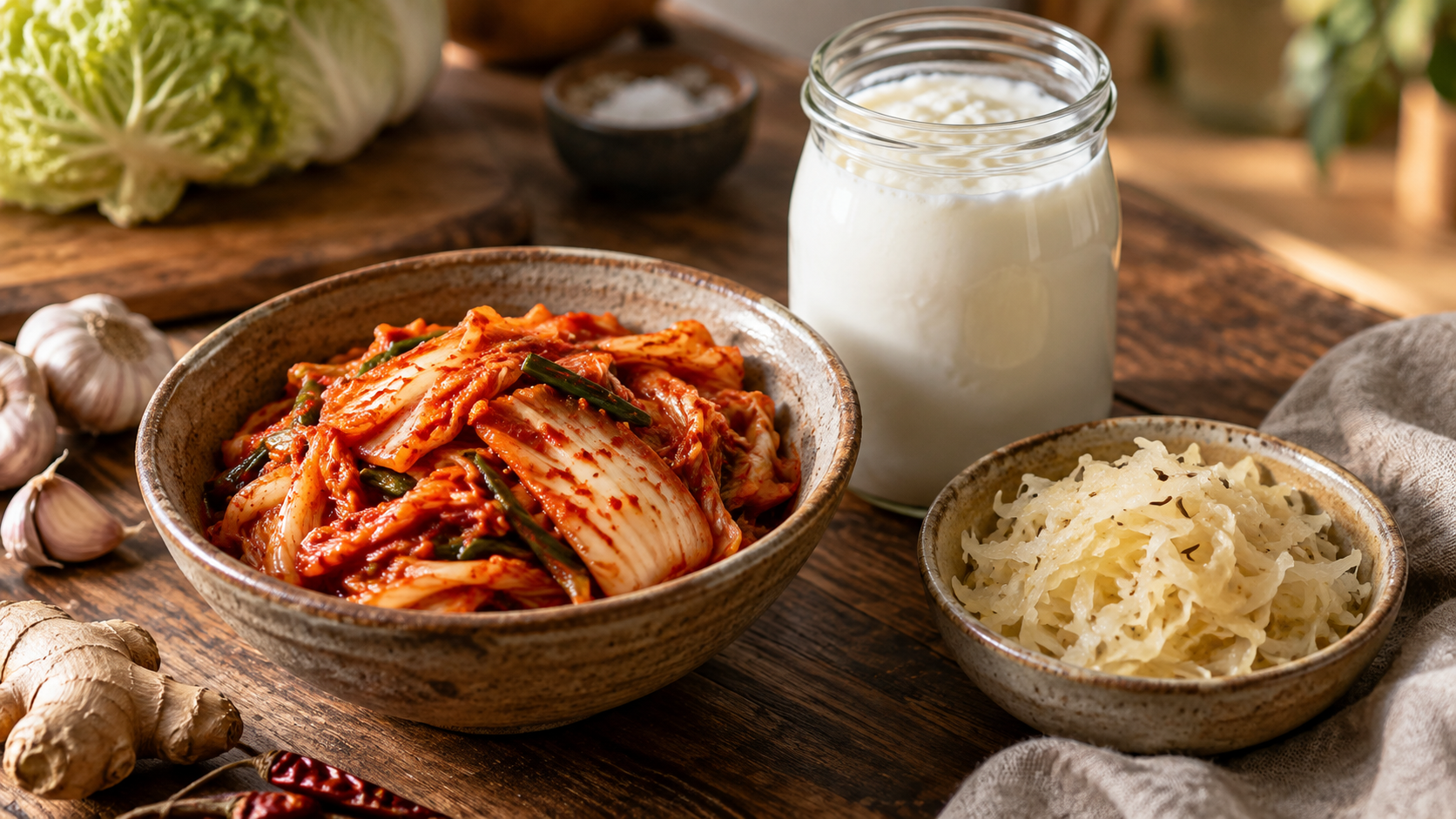
Kimchi is a traditional Korean fermented vegetable preparation, typically made from napa cabbage and radishes with garlic, ginger, chili pepper, and salt. It has been consumed for over two thousand years. The fermentation process is driven by lactic acid bacteria, including Leuconostoc and Lactobacillus species, which produce organic acids, enzymes, and bioactive compounds that preserve the food and confer health benefits.
Modern science has confirmed what traditional cultures understood intuitively: fermented foods support gut health in ways that go beyond simple probiotic supplementation. The fermentation process breaks down complex carbohydrates, reduces anti-nutrients like phytic acid, increases the bioavailability of vitamins including B12 and K2, and generates postbiotic metabolites that interact directly with immune cells and the intestinal barrier. A landmark Stanford study found that participants who consumed fermented foods daily for ten weeks showed significant reductions in inflammatory markers, including interleukin-6, compared to those on a high-fiber diet alone.
The kimchi nanoplastics discovery adds a new dimension to this picture. The same fermentation environment that produces beneficial acids and enzymes also cultivates microbial strains with the surface chemistry to bind environmental toxins. This is not a coincidence. It reflects the complexity of the microbial ecosystems that traditional fermented foods have preserved across generations.
Other fermented foods carry related benefits. Kefir, a fermented milk drink, contains a diverse community of bacteria and yeasts that support microbial diversity and gut barrier integrity. Sauerkraut, fermented cabbage, provides similar lactic acid bacteria alongside glucosinolates from the brassica family that support liver detoxification. Miso, tempeh, and traditionally fermented pickles each contribute distinct microbial and biochemical profiles. The common thread is the living, active microbial community that fermentation produces.
God's Design for Protection: The Body as a Living Filter
"Do you not know that your bodies are temples of the Holy Spirit, who is in you, whom you have received from God? You are not your own; you were bought at a price. Therefore honor God with your bodies." — 1 Corinthians 6:19-20
The discovery that a bacterium found in traditional fermented food can bind and remove environmental toxins from the gut is not merely a scientific curiosity. It is a window into the extraordinary complexity of the body God designed. The gut microbiome is not an accident of evolution. It is a carefully constructed ecosystem, shaped over millennia, that equips the body to navigate a world full of environmental challenges.
Scripture calls us to honor God with our bodies. In the context of a world saturated with plastic pollution, that call to stewardship takes on a practical dimension. We cannot eliminate nanoplastic exposure entirely. They are in the water, the air, and the food supply. But we can support the body's built-in defense systems through the choices we make about what we eat and how we care for our gut.
The wisdom of traditional fermented foods, preserved across cultures and centuries, turns out to be a form of creation stewardship that modern science is only beginning to understand. When God designed the human gut with its intricate microbial ecosystem, He built in a capacity for resilience and renewal that continues to reveal itself through research like this.
Practical Steps: Supporting Your Gut's Defense Against Nanoplastics
The research on L. mesenteroides CBA3656 is promising but still in early stages. Human clinical trials have not yet been completed. What the science does support is a broader strategy for gut health that reduces nanoplastic accumulation and supports the body's natural excretion pathways.
Incorporate traditionally fermented foods daily. Kimchi, kefir, sauerkraut, miso, and naturally fermented pickles provide live lactic acid bacteria that support microbial diversity and gut barrier integrity. Look for products labeled "naturally fermented" or "live, active cultures." Pasteurized versions do not contain live bacteria.
Reduce plastic contact with food and water. Store food in glass or stainless steel containers rather than plastic. Avoid heating food in plastic containers, which accelerates leaching. Filter drinking water with a high-quality filter certified to remove microplastics. Choose fresh, whole foods over heavily packaged processed products.
Support liver and gut detoxification pathways. The liver is the body's primary detoxification organ, and the gut is its partner in excretion. Cruciferous vegetables (broccoli, cauliflower, Brussels sprouts, cabbage) support liver phase II detoxification enzymes. Adequate fiber intake supports regular bowel movements, which is the primary route for excreting bound toxins. Hydration supports kidney filtration.
Protect gut barrier integrity. A compromised gut barrier allows nanoplastics easier access to the bloodstream. Chronic stress, poor sleep, ultra-processed foods, and antibiotic overuse all damage the gut lining. Prioritizing sleep, managing stress, and eating a diverse whole-food diet supports the tight junctions that keep the gut barrier intact.
Minimize ultra-processed food consumption. Ultra-processed foods are both a source of nanoplastic contamination (from packaging) and a driver of gut dysbiosis that weakens the body's defenses. The 2026 European Heart Journal study linking food preservatives to cardiovascular risk is a reminder that what we eat shapes our internal environment in ways that compound over time.
Genesis World Health's Gut Microbiome specialist can help you assess your current gut health, identify dysbiosis patterns, and build a personalized approach to supporting your microbiome. The Detoxification specialist offers guidance on reducing toxic burden and supporting the body's natural elimination pathways. Together, these perspectives address both the microbial and biochemical dimensions of environmental protection.
What This Means for the Future of Environmental Medicine
The kimchi probiotic discovery represents a new frontier in what researchers are calling "microbial biosorbents," the use of living or non-living microbial material to sequester environmental toxins in the gut before they reach systemic circulation. A parallel 2026 study published in Frontiers in Microbiology demonstrated that heat-inactivated Limosilactobacillus fermentum preparations could physically associate with nanoplastics and reduce their uptake by intestinal cells, suggesting that even non-viable microbial material may offer protective effects.
This field is young, and the translation from animal models to human clinical outcomes will take time. But the direction of the science is clear: the gut microbiome is not just a digestive accessory. It is an active participant in the body's response to environmental toxins, and the microbial diversity supported by traditional fermented foods may be one of the most practical tools available for reducing the body's plastic burden.
For Genesis World Health members, this research reinforces the integrative approach that guides everything we do. Environmental medicine, gut health, nutrition, and detoxification are not separate silos. They are interconnected dimensions of whole-person stewardship. The body God designed is not passive in the face of environmental challenge. It is equipped, when properly supported, to fight back.
Support Your Gut's Natural Defenses
Genesis World Health's Gut Microbiome and Detoxification specialists are ready to help you build a whole-person approach to reducing your toxic burden and strengthening your body's built-in protection systems. Explore our membership plans and consult both specialists inside Genesis World Health.
A Personal Note from Genesis World Health
The information shared in this article is for educational purposes and reflects our commitment to integrating faith, science, and whole-person wellness. It is not a substitute for professional medical advice, diagnosis, or treatment. Every person's health journey is unique — fearfully and wonderfully made — and what works for one may not be right for another.
We encourage you to consult with gastroenterologists, environmental medicine physicians, functional medicine practitioners, and your primary care provider when making significant changes to your approach to gut health and environmental toxin reduction. Our prayer is that this knowledge empowers you to make informed, faith-guided decisions for the body God has entrusted to you.
Sources & References
- Lee SH, Whon TW, et al. "Efficient biosorption of nanoplastics by food-derived lactic acid bacterium." Bioresource Technology, Volume 447, 2026. https://www.sciencedirect.com/science/article/abs/pii/S0960852426003159
- Nihart AJ, et al. "Bioaccumulation of microplastics in decedent human brains." Nature Medicine, 2024. https://www.nature.com/articles/s41591-024-03453-1
- Wastyk HC, et al. "Gut-microbiota-targeted diets modulate human immune status." Cell, 2021. https://pmc.ncbi.nlm.nih.gov/articles/PMC9003261/
- "Kimchi-derived probiotic shows promise for nanoplastic elimination." NutraIngredients, 2026. https://www.nutraingredients.com/Article/2026/04/13/kimchi-derived-probiotic-shows-promise-for-nanoplastic-elimination/
- Frontiers in Microbiology. "Postbiotic sequestration of nanoplastics in the gut." 2026. https://www.frontiersin.org/journals/microbiology/articles/10.3389/fmicb.2026.1881786/full
- Nature Reviews Gastroenterology & Hepatology. "Microplastics and nanoplastics in the human gut." 2026. https://www.nature.com/articles/s41575-026-01185-w