God's Botanical Pharmacy for Menopause: What Shatavari, Fenugreek, and Ancient Plant Medicine Reveal About Hormonal Healing
Creation's Pharmacy Has Always Known What Women Need
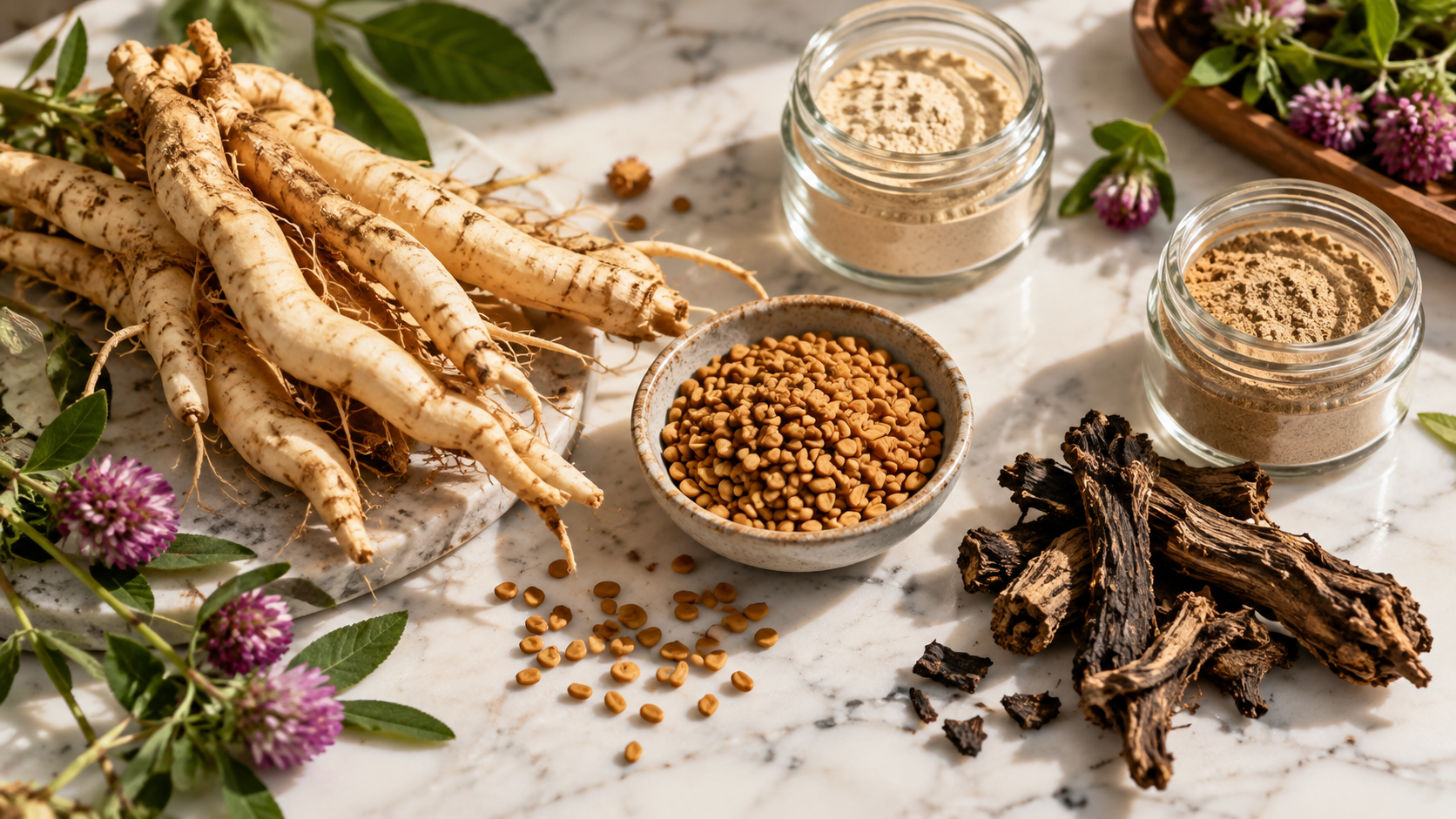
Long before pharmaceutical companies synthesized estrogen in a laboratory, women navigating the menopausal transition turned to the earth. Shatavari root from the forests of India. Fenugreek seeds ground into golden powder. Black cohosh harvested from North American woodlands. Red clover blossoms steeped into tea. These were not folk remedies born of desperation. They were the accumulated wisdom of generations of women who understood, intuitively, what modern science is now confirming: God placed within His creation a botanical pharmacy designed to support women through every season of life.
Proverbs 31 describes a woman of strength and dignity who "laughs at the days to come." That confidence is not accidental. It is the fruit of a life rooted in wisdom, including the wisdom to steward the body God has entrusted to her. For the millions of women navigating perimenopause and menopause today, that stewardship increasingly includes a return to plant medicine, validated now not only by tradition but by rigorous clinical science.
A landmark 2026 randomized controlled trial published in Women's Health Reports has brought new credibility to two of Ayurveda's most celebrated female tonics: shatavari (Asparagus racemosus) and fenugreek (Trigonella foenum-graecum). The findings are striking. And they point toward something larger than symptom relief. They point toward a design.
What the 2026 Fenavari Trial Found
The study enrolled 150 women aged 40 to 60 who were experiencing at least two daily menopausal or perimenopausal symptoms. Participants were randomized into three groups: a low-dose group receiving 300 mg per day of a standardized shatavari-fenugreek extract called Fenavari, a high-dose group receiving 500 mg per day, and a placebo group. The intervention lasted 84 days.
The results were measured using validated clinical instruments: the Menopause Rating Scale (MRS) for overall symptom burden, the Pittsburgh Sleep Quality Index (PSQI) for sleep, the Beck Anxiety Inventory (BAI) for anxiety, and serum hormonal panels tracking estradiol, progesterone, and follicle-stimulating hormone (FSH).
By Day 84, the findings were clear:
- Hot flashes decreased by up to 52% in the 300 mg group and up to 61% in the 500 mg group, compared to placebo.
- Night sweats decreased by up to 47% at 300 mg and up to 51% at 500 mg.
- Sleep quality, mood, and anxiety scores improved significantly in both active groups.
- Serum estradiol levels increased while FSH levels decreased, indicating meaningful hormonal modulation.
- Improvements began as early as Day 14, with no treatment-related adverse events across the entire trial.
The extract works through complementary mechanisms. Shatavari contributes steroidal saponins called shatavarins, particularly Shatavarin-IV, which exert phytoestrogenic and adaptogenic effects on the hypothalamic-pituitary-ovarian axis. Fenugreek contributes Protodioscin, another steroidal saponin with documented hormonal-modulating properties. Together, they address the vasomotor instability, neurological disruption, and hormonal fluctuation that define the menopausal transition, without the risks associated with conventional hormone replacement.
Shatavari: The Queen of Herbs for Women
In Ayurvedic medicine, shatavari is called the "queen of herbs" for women. Its Sanskrit name translates roughly as "she who possesses a hundred husbands," a reference to its traditional role as a female reproductive tonic capable of supporting women through every stage of life, from adolescence through menopause and beyond.
Modern pharmacology has begun to explain what Ayurvedic physicians observed empirically over centuries. The root of Asparagus racemosus contains a rich phytochemical profile: steroidal saponins (shatavarins), flavonoids, alkaloids, quercetin glycosides, and phytoestrogens. These compounds interact with estrogen receptors in ways that help stabilize hormonal signaling without the all-or-nothing potency of synthetic estrogen.
Beyond vasomotor symptoms, research has documented shatavari's effects on bone density (relevant to postmenopausal osteoporosis risk), antioxidant activity, anti-inflammatory pathways, and immune modulation. A 2025 systematic review in the International Journal of Women's Health found that standardized shatavari root extract significantly reduced hot flash frequency and intensity, improved sleep quality, and supported hormonal balance across multiple randomized controlled trials.
Genesis World Health's Women's Health Digital Health Agent and Ayurveda Digital Health Agent both offer educational perspectives on adaptogenic botanicals and their role in supporting women through hormonal transitions. These agents share insights drawn from both traditional Ayurvedic frameworks and contemporary clinical research, helping members understand how plant medicine fits within a whole-person approach to women's wellness.
Fenugreek: More Than a Kitchen Spice
Fenugreek has been used medicinally for at least 4,000 years, appearing in ancient Egyptian, Greek, Roman, and Indian medical traditions. In Ayurveda, it is classified as a warming, nourishing herb with particular affinity for the female reproductive system. In traditional Chinese medicine, it is used to tonify kidney yang and support hormonal vitality.
The active compound Protodioscin, a steroidal saponin found in fenugreek seeds, has been shown to influence the hypothalamic-pituitary axis and support healthy testosterone and estrogen metabolism. In the context of menopause, this translates to support for vasomotor stability, mood regulation, and libido, areas where many women experience significant disruption during the menopausal transition.
The 2026 Fenavari trial demonstrated that the combination of shatavari and fenugreek produces synergistic effects that neither herb achieves alone. The integrated extraction process used in Fenavari ensures that the active saponins from both plants are delivered in a standardized, bioavailable form, addressing one of the longstanding challenges of botanical medicine: consistency of potency.
The Broader Botanical Pharmacy: Black Cohosh, Red Clover, and Ashwagandha
Shatavari and fenugreek are not the only plants in God's botanical pharmacy for women. A growing body of research supports several other botanicals for menopausal support, each with distinct mechanisms and evidence profiles.
Black cohosh (Cimicifuga racemosa) is among the most studied botanical options for menopause. A 2026 systematic review informing International Menopause Society recommendations found moderate-certainty evidence supporting black cohosh for vasomotor symptoms and overall menopausal scores, with benefits appearing within 4 to 52 weeks of use and a favorable safety profile in short-term studies.
Red clover (Trifolium pratense) is rich in isoflavones, plant compounds that structurally resemble estrogen. While evidence for red clover is more mixed than for black cohosh or shatavari, some trials have documented improvements in hot flash frequency and bone density markers. Its isoflavone content, including formononetin, biochanin A, daidzein, and genistein, provides a broad phytoestrogenic spectrum.
Ashwagandha (Withania somnifera) is an adaptogenic herb with documented effects on cortisol regulation, thyroid function, and stress resilience. Research has shown that combining ashwagandha with shatavari produces enhanced synergistic improvements in stress adaptation and overall menopausal symptom scores, addressing the HPA axis dysregulation that often accompanies the menopausal transition.
The U.S. menopause supplement category is projected to approach $819 million by the end of 2026, reflecting a cultural shift toward botanical and integrative approaches. Women are not abandoning conventional medicine. They are expanding their toolkit, seeking options that honor the body's own intelligence and the wisdom embedded in creation.
Scripture and the Wisdom of Plant Medicine
"He makes grass grow for the cattle, and plants for people to cultivate, bringing forth food from the earth." — Psalm 104:14
The biblical worldview has always recognized plants as part of God's provision for human health. Ezekiel 47:12 describes trees whose "leaves are for healing." Revelation 22:2 echoes the same image in the new creation. The book of Sirach, part of the deuterocanonical wisdom tradition, states plainly: "The Lord created medicines from the earth, and a sensible person will not hesitate to use them."
This is not a peripheral theological point. It is a foundational one. God did not create the human body and then leave it without resources. He embedded within creation the very compounds that support hormonal balance, reduce inflammation, calm the nervous system, and sustain vitality through every life stage. The woman navigating menopause who reaches for shatavari root is not abandoning faith for folk medicine. She is exercising the stewardship God called her to, drawing on the provision He placed in the earth.
The Proverbs 31 woman is described as one who "considers a field and buys it." She is discerning. She evaluates. She acts with wisdom. That same discernment applies to health decisions, including the decision to explore what God's botanical pharmacy offers for the menopausal transition.
Integrating Botanical Medicine with Whole-Person Care
Botanical medicine for menopause is not a replacement for comprehensive care. It is one layer of a whole-person approach that may also include nutritional support, movement, stress management, and sleep hygiene.
The evidence for shatavari and fenugreek is strongest when these botanicals are used as part of a broader lifestyle foundation. The 2026 Fenavari trial participants who saw the greatest improvements were those who maintained consistent supplementation alongside general wellness practices. This mirrors what integrative medicine has long understood: the body heals best when multiple systems are supported simultaneously.
Genesis World Health's 68 Digital Health Agents include perspectives from Ayurveda, Women's Health, Nutrition, and Hormone and Endocrine health, offering members a way to explore how botanical medicine fits within their individual health picture.
The menopausal transition is not a malfunction. It is a passage. And like every passage in a woman's life, it is one that God designed the body to navigate, with wisdom, with support, and with the resources He placed in creation for exactly this purpose.
Explore God's Botanical Pharmacy with Genesis World Health
Genesis World Health's 68 Digital Health Agents include Ayurveda, Women's Health, Nutrition, and Hormone and Endocrine perspectives, giving you a whole-person view of botanical medicine for hormonal health.
A Personal Note from Genesis World Health
The information shared in this article is for educational purposes and reflects our commitment to integrating faith, science, and whole-person wellness. It is not a substitute for professional medical advice, diagnosis, or treatment. Every person's health journey is unique, and what works for one may not be right for another.
We encourage you to consult with gynecologists, integrative medicine physicians, licensed naturopathic doctors, and your primary care provider when making significant changes to your approach to managing menopausal symptoms and hormonal health. Our prayer is that this knowledge empowers you to make informed, faith-guided decisions for the body God has entrusted to you.
Sources & References
- Fenavari (Shatavari + Fenugreek) RCT, Women's Health Reports, July 2026. https://pmc.ncbi.nlm.nih.gov/articles/PMC13421819/
- Shatavari (Asparagus racemosus) for perimenopausal and menopausal symptoms, International Journal of Women's Health, 2025. https://www.dovepress.com/efficacy-and-safety-of-shatavari-asparagus-racemosus-root-extract-for--peer-reviewed-fulltext-article-IJWH
- Black cohosh and botanical medicine for menopause: systematic review, PMC, June 2026. https://pmc.ncbi.nlm.nih.gov/articles/PMC13363246/
- Shatavari phytochemistry and adaptogenic mechanisms, PMC, November 2025. https://pmc.ncbi.nlm.nih.gov/articles/PMC12695842/
- Shatavari root extract for menopausal symptoms: clinical evidence, PMC, April 2024. https://pmc.ncbi.nlm.nih.gov/articles/PMC11079574/
- Botanical medicine for menopause: IMS recommendations update, Climacteric, January 2026. https://doi.org/10.1080/13697137.2025.2584061