Healing Through Sound: What Shockwave Therapy Reveals About God's Design for Tissue Repair and Pain Relief
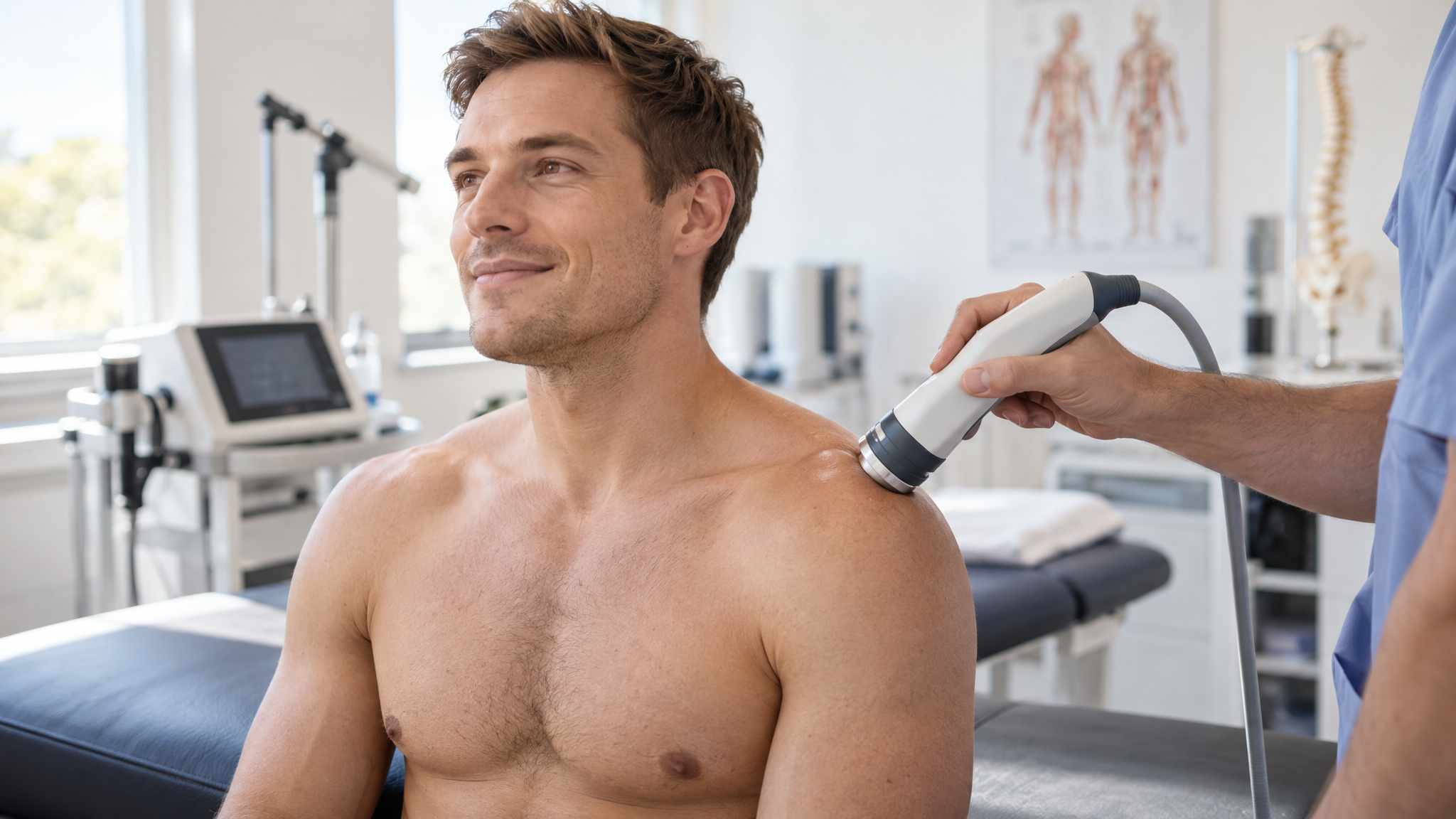
Sound Waves and the Body's Design
Pain is one of the most universal human experiences, and one of the most humbling. Whether it is the sharp sting of plantar fasciitis with every morning step, the grinding ache of a tendon that refuses to heal, or the slow frustration of a wound that will not close, chronic pain and tissue injury have a way of reminding us that our bodies are finite. Yet Scripture also reminds us that these bodies are not accidents. They are designed with extraordinary capacity for repair, renewal, and restoration. Genesis World Health's Pain Management, Structural & Musculoskeletal, and Regenerative Medicine Digital Health Agents offer educational perspectives on how emerging approaches like this one fit into that bigger picture.
One of the most fascinating developments in integrative and regenerative medicine is the growing use of extracorporeal shockwave therapy (ESWT), a noninvasive approach that uses acoustic pressure waves to stimulate the body's own repair pathways. In 2026, shockwave therapy has become one of the fastest-rising health searches, with over 60,000 monthly queries and growing adoption across orthopedic, wound care, and integrative medicine settings. But what does the science actually show? And how does this technology fit within a faith-centered, whole-person approach to health?
What Is Shockwave Therapy?
Extracorporeal shockwave therapy delivers controlled acoustic pressure waves to targeted tissue from outside the body, hence "extracorporeal," meaning outside the body. These waves are not electrical shocks; they are mechanical sound waves, similar in principle to the way ultrasound works, but with a different energy profile and biological effect.
There are two main types of shockwave devices used clinically:
- Focused ESWT: Concentrates energy at a precise, deeper target point within tissue. It is often used for tendons, calcific deposits, and deeper structures.
- Radial pressure-wave therapy: Disperses energy outward from the applicator across a broader, more superficial area. It is often used for muscle groups and surface-level conditions.
These two technologies differ physically and should not be assumed interchangeable. The evidence for each is condition-specific, and the device type, energy level, pulse count, and session frequency all influence outcomes. This nuance matters, and it is one reason results in one study do not automatically carry over to another device or setting.
The Science of Mechanotransduction: How Sound Becomes Healing
The central mechanism behind shockwave therapy is a process called mechanotransduction: the conversion of a mechanical stimulus into a biological response at the cellular level. When acoustic waves contact tissue, they create mechanical stress that cell membranes detect through specialized structures, including mechanosensitive ion channels. This triggers a cascade of intracellular signaling that can influence tissue repair, inflammation, pain modulation, and vascular activity.
Research has associated ESWT with several specific biological effects:
- VEGF and angiogenesis: Shockwave exposure has been linked to increased expression of vascular endothelial growth factor (VEGF) and endothelial nitric oxide synthase, signals associated with new blood vessel formation (neovascularization) and improved microcirculation in damaged tissue.
- Collagen and extracellular-matrix remodeling: Mechanical stimulation may influence fibroblast activity and the production and organization of collagen, which is particularly relevant in tendon repair and scar remodeling.
- Inflammation and pain modulation: Reviews describe effects on inflammatory cytokine signaling and neurotransmitter regulation, including changes in Substance P, which may contribute to pain relief.
It is important to hold these findings with appropriate humility: demonstrating that a molecular pathway changes after shockwave exposure does not automatically prove that the pathway caused a participant's improvement. The science is promising and mechanistically coherent, but it is not a guarantee of outcome for every person or every condition.
Where the Evidence Is Strongest
The clinical evidence for shockwave therapy is not uniform across all conditions. Here is an honest summary of where the research is most and least supportive:
Plantar Fasciitis
This is where ESWT has its strongest evidence base. A 2025 network meta-analysis supports ESWT as an effective noninvasive option for reducing plantar fasciitis pain and improving function compared with placebo. Studies have also reported reduced plantar fascia thickness after shockwave sessions. ESWT is one useful option within a broader plan, not a universal answer, and some analyses suggest PRP or custom orthotics may offer advantages in certain outcomes. The most defensible conclusion: shockwave therapy belongs in the conversation for plantar fasciitis, alongside rehabilitation and biomechanical correction.
Calcific and Tendinopathies
ESWT appears particularly relevant to calcific tendinopathy, especially calcific rotator-cuff disease, where high-energy approaches have shown improvements in pain, function, and calcific-deposit resorption. A 2025 systematic review of hip and pelvic tendinopathies also reported improvements in pain and function, with adverse events (mainly minor skin irritation or temporary increased pain) in about 12% of participants. Results should not be generalized to every tendon disorder. Evidence for patellar and Achilles tendinopathy has been more mixed.
Diabetic Foot Ulcers and Chronic Wounds
Meta-analysis supports ESWT as a potentially useful adjunct to standard care for diabetic foot ulcers, with reported improvements in complete-healing rates, healing time, and tissue oxygenation. The biological rationale includes angiogenic signaling and improved perfusion in tissue where circulation may be compromised. The critical word here is "adjunct": shockwave therapy does not replace wound assessment, debridement, pressure off-loading, infection management, or glucose control. It may support healing when added to comprehensive wound care.
Neurological Rehabilitation
Review-level evidence suggests ESWT may reduce spasticity and pain and improve passive range of motion or motor function after stroke and in cerebral palsy. These findings are promising rather than definitive, since studies differ in their methods, target location, and neurological diagnosis. ESWT should be considered a possible rehabilitation adjunct, not a replacement for comprehensive neurological care.
Erectile Dysfunction
The 2025 Cochrane review of 21 randomized trials found that low-intensity shockwave therapy produced a small short-term improvement in erectile-function scores compared with sham sessions, but the average improvement fell below the threshold for clinical importance, and certainty was rated low. Some other reviews report more favorable results for vasculogenic erectile dysfunction. The honest summary: there may be modest benefit for some men, but clinical importance, durability, and optimal approaches remain uncertain. Erectile changes are also associated with cardiovascular and metabolic conditions, which is one more reason this area deserves careful attention rather than a quick fix.
God's Design for Self-Repair
"For you formed my inward parts; you knitted me together in my mother's womb. I praise you, for I am fearfully and wonderfully made." — Psalm 139:13-14
What strikes many people about shockwave therapy is not that it introduces a foreign substance or implants something new. It is that it activates what is already there. The body's repair pathways, including VEGF signaling, collagen synthesis, inflammatory resolution, and neovascularization, are not inventions of modern medicine. They are part of the extraordinary biological architecture that God designed into every human body.
Shockwave therapy, at its best, is a tool that speaks the body's own language: mechanical stimulus, cellular response, tissue renewal. It does not override the body's design; it works with it. This is the essence of what integrative and regenerative medicine seeks to do: support the body's God-given capacity for restoration, rather than simply suppressing symptoms.
"He heals the brokenhearted and binds up their wounds." — Psalm 147:3
This does not mean every approach works for every person, or that faith guarantees a particular medical outcome. It means that caring for the body by seeking clear understanding, weighing evidence honestly, and choosing with wisdom is itself an act of stewardship. We are called to tend what we have been given.
Shockwave Therapy vs. PRP and Peptides: An Honest Comparison
Shockwave therapy is often discussed alongside other regenerative approaches like platelet-rich plasma (PRP) injections and peptides. Here is a calibrated comparison:
- ESWT: Noninvasive mechanical stimulus with a condition-specific clinical evidence base. Best supported for plantar fasciitis, calcific tendinopathy, and wound healing as an adjunct. Main uncertainty: device and method variability.
- PRP: Autologous blood-derived injection with clinical evidence, but preparation varies significantly in platelet concentration, leukocyte content, and activation method. Some plantar-fasciitis analyses favor PRP for certain outcomes. Not a uniform intervention.
- Peptides (e.g., BPC-157): Bioactive compounds with mostly preclinical or limited human data. A 2025 systematic review found that most support comes from laboratory and animal research, while robust human trials are inadequate. Efficacy, product consistency, and long-term safety remain uncertain.
ESWT has a more developed human clinical literature for several defined conditions, but that does not make it universally superior. These approaches are best compared by condition, evidence quality, procedural risk, and compatibility with foundational care.
What to Expect: Safety and Practical Considerations
Shockwave therapy is generally well-tolerated, but it is not without side effects. Common short-term effects include:
- Local pain during or after a session, often described as a deep aching or pressure sensation
- Temporary redness or bruising at the applicator site
- Minor skin irritation
- A transient increase in symptoms in the first 24-48 hours after a session
Serious adverse events were not prominent in musculoskeletal reviews, but reporting and follow-up varied across studies. The research summarized here was conducted in people with a confirmed, specific condition, and results depend on matching the device type, tissue depth, and energy level to that condition. A trending health topic on its own is not a reason to try it.
For those living with chronic musculoskeletal conditions or slow-healing wounds, Genesis World Health's personal assessment shows how insights from different health traditions may relate to your journey, and Deep Dives open the conversation further on topics like tissue repair, recovery, and pain.
An Integrative Approach: Shockwave Therapy in Context
The most important principle in integrative medicine is that no single tool, however promising, replaces a comprehensive approach. Shockwave therapy works best when it is part of a broader plan that includes:
- Clear understanding of the condition: Knowing the specific condition, its severity, and its contributing factors
- Progressive rehabilitation: Loading programs, mobility work, and physical therapy that address biomechanical contributors
- Nutritional support: Anti-inflammatory nutrition that supports tissue repair and reduces systemic inflammation
- Metabolic support: For wound healing especially, blood sugar balance and vascular health are foundational
- Rest and recovery: Honoring the body's need for adequate sleep and recovery time
Genesis World Health's AI Agent Council brings together perspectives from Clinical Medicine, Integrative Medicine, Nutrition, and other areas to support exactly this kind of whole-person thinking. For those interested in regenerative options, the VIP-exclusive Regenerative Medicine agent offers educational perspectives on emerging approaches like ESWT, PRP, and peptide science, helping members understand the evidence landscape as part of a broader integrative health conversation. Rather than isolating one approach, the platform helps members explore how multiple evidence-informed approaches may work together to support the body's God-given capacity for restoration.
A Note on Hope and Humility
For anyone living with chronic pain or a slow-healing injury, the appeal of a new approach is understandable and legitimate. Hope is not naïve. But hope is best served by honesty. Shockwave therapy is a genuinely promising tool with real evidence behind it for specific conditions. It is not a miracle cure, and it is not right for every person or every condition.
"But those who hope in the Lord will renew their strength. They will soar on wings like eagles; they will run and not grow weary, they will walk and not be faint." — Isaiah 40:31
Whether your path to restoration includes shockwave therapy, physical rehabilitation, nutrition, prayer, or all of the above, the goal is the same: to steward the body you have been given with wisdom, care, and faith.
Explore Your Regenerative Health Options
Genesis World Health's 68 Digital Health Agents, including the Pain Management, Structural & Musculoskeletal, and VIP-exclusive Regenerative Medicine agents, offer educational insights on emerging approaches like shockwave therapy with evidence-based clarity and whole-person wisdom.
A Personal Note from Genesis World Health
The information shared in this article is for educational purposes and reflects our commitment to integrating faith, science, and whole-person wellness. It is not a substitute for professional medical advice, diagnosis, or treatment. Every person's health journey is unique, and what works for one may not be right for another.
We encourage you to consult with sports medicine physicians, physical therapists, wound care specialists, and your primary care provider when making significant changes to your approach to chronic pain, tendon injuries, or slow-healing wounds. Our prayer is that this knowledge empowers you to make informed, faith-guided decisions for the body God has entrusted to you.
Sources & References
- Cheng JH, Wang CJ. Biological mechanism of shockwave in bone. Int J Surg. 2015. PubMed PMID 36351147
- Liao CD, et al. Comparative effectiveness of extracorporeal shockwave therapy for plantar fasciitis: a network meta-analysis. 2025. PubMed PMID 40709373
- Maffulli N, et al. Extracorporeal shockwave therapy for hip and pelvic tendinopathies: a systematic review. 2025. PubMed PMID 40292269
- Huang Y, et al. Extracorporeal shockwave therapy for diabetic foot ulcers: a meta-analysis. 2024. PubMed PMID 39237040
- Cochrane Review. Low-intensity shockwave therapy for erectile dysfunction. 2025. PubMed PMID 40654049
- Sikiric P, et al. BPC-157 systematic review: preclinical and clinical evidence. 2025. PubMed PMID 40756949