The Ultra-Processed Food Crisis: How Emulsifiers, Additives, and Fake Food Are Destroying Your Gut Microbiome
The Ultra-Processed Food Crisis: How Emulsifiers, Additives, and Fake Food Are Destroying Your Gut Microbiome
Something is happening inside the gut of the average American — and it is not subtle. Microbial diversity is collapsing. The protective mucus layer that lines the intestinal wall is thinning. Beneficial bacteria that have coexisted with human biology for millennia are disappearing. And the primary driver is not a pathogen, a toxin, or a genetic defect. It is the food sitting in most people's pantries right now.
Ultra-processed foods (UPFs) — the packaged, shelf-stable, industrially formulated products that now account for more than 57% of calories consumed in the United States — are not simply "unhealthy." They are actively dismantling the gut ecosystem that governs your immune function, your mood, your metabolic health, and your long-term disease risk. The mechanisms are specific, measurable, and increasingly well-documented in peer-reviewed science.
This is not a general "eat clean" post. This is a root-cause examination of exactly how ultra-processed foods damage the microbiome — and what you can do to rebuild it.
What Makes a Food "Ultra-Processed"?
The NOVA classification system, developed by nutrition researcher Carlos Monteiro and colleagues at the University of São Paulo, categorizes foods into four groups based on the nature and extent of industrial processing. Group 4 — ultra-processed foods — is defined not by any single ingredient but by the presence of industrial formulations that include substances rarely or never used in home cooking: emulsifiers, non-sugar sweeteners, artificial colorants, flavor enhancers, anti-caking agents, and preservatives.
These are not foods that have simply been cooked or preserved. They are engineered products — designed in laboratories to maximize palatability, shelf life, and profit margins. The ingredients list reads like a chemistry textbook: carboxymethylcellulose, polysorbate-80, carrageenan, sodium benzoate, high-fructose corn syrup, partially hydrogenated oils, artificial flavors. Each of these compounds has been individually tested for acute toxicity. Almost none have been evaluated for their long-term, combined effects on the living ecosystem of the human gut.
Mechanism 1: Emulsifiers Erode the Intestinal Mucus Layer
The gut is lined with a protective mucus layer — a gel-like barrier that maintains a critical distance between the trillions of bacteria in the intestinal lumen and the epithelial cells of the gut wall. This mucus layer is not passive. It is a dynamic, living structure produced by goblet cells, constantly renewed, and home to a specialized community of bacteria that help maintain its integrity.
Emulsifiers — the additives used to blend oil and water in processed foods and give them their smooth, creamy texture — are among the most damaging compounds to this barrier. Research led by Benoit Chassaing at the Institut Pasteur has demonstrated that common emulsifiers, including carboxymethylcellulose (CMC) and polysorbate-80 (P80), directly erode the intestinal mucus layer. When this barrier thins, gut bacteria migrate closer to the epithelial wall — a phenomenon that triggers a cascade of inflammatory responses.
In animal studies, mice fed emulsifiers at concentrations comparable to human dietary exposure developed low-grade intestinal inflammation, increased gut permeability, and metabolic syndrome. In human clinical trials, individuals with Crohn's disease placed on an emulsifier-restricted diet experienced significant symptom reduction compared to those on a standard diet. The mechanism is not theoretical — it is observable, measurable, and reproducible.
Akkermansia muciniphila, one of the most important bacteria in the gut ecosystem, is particularly vulnerable to emulsifier exposure. This keystone species lives in and feeds on the mucus layer itself, and its abundance is strongly associated with metabolic health, reduced inflammation, and gut barrier integrity. When emulsifiers thin the mucus layer, Akkermansia populations collapse — and with them, a critical pillar of gut health.
Mechanism 2: The Cocktail Effect — When Additives Combine
Here is where the science becomes particularly alarming. Food additives are approved for use based on individual toxicity testing — each compound evaluated in isolation for its capacity to cause acute harm or DNA damage. What regulators have historically not tested is what happens when dozens of these compounds are consumed simultaneously, day after day, across a lifetime.
Scientists call this the "cocktail effect." Emerging laboratory evidence on human cells demonstrates that the combination of commonly consumed additives — sweeteners, dyes, emulsifiers, and preservatives consumed together — produces biological effects that are not captured by single-compound testing. The cumulative, synergistic disruption of the gut microbiome from multiple additives consumed in combination is measurably greater than the sum of their individual effects.
A 2026 review published in Frontiers in Public Health concluded that current regulatory frameworks for food additives are fundamentally inadequate because they assess individual compounds rather than the complex, real-world dietary patterns in which these compounds are consumed. The gut microbiome, which is exquisitely sensitive to chemical signals, does not experience additives one at a time — it experiences the full cocktail with every meal.
Mechanism 3: Fiber Deficiency and the Collapse of Beneficial Bacteria
Ultra-processed foods are, almost by definition, fiber-depleted. The industrial processing that creates their smooth textures, extended shelf lives, and consistent flavors strips away the plant cell wall structures — the "acellular carbohydrates" — that serve as the primary food source for beneficial gut bacteria.
Two bacterial species bear particular mention here: Akkermansia muciniphila and Faecalibacterium prausnitzii. Both are considered keystone species in a healthy gut ecosystem, and both are dramatically reduced in individuals who consume high-UPF diets.
Faecalibacterium prausnitzii is one of the most abundant bacteria in a healthy human gut and one of the primary producers of butyrate — a short-chain fatty acid (SCFA) that serves as the main energy source for colonocytes (the cells lining the colon), maintains intestinal barrier integrity, and exerts powerful anti-inflammatory effects. When fiber disappears from the diet, F. prausnitzii starves. Butyrate production drops. The intestinal lining weakens. Inflammation rises.
Randomized controlled trials comparing high-UPF diets to diets based on minimally processed whole foods have found that, even when calorie intake and macronutrient profiles are held constant, the high-UPF group experiences significantly lower gut microbial diversity and measurably higher rates of gastrointestinal symptoms including bloating, constipation, and abdominal pain. The difference is not calories — it is the living ecosystem that processes those calories.
Mechanism 4: Leaky Gut, the NLRP3 Inflammasome, and Systemic Inflammation
When the mucus layer erodes, when beneficial bacteria collapse, and when the intestinal barrier weakens, the result is increased intestinal permeability — commonly called "leaky gut." This is not a fringe concept. It is a measurable physiological state in which the tight junctions between intestinal epithelial cells loosen, allowing microbial products — particularly lipopolysaccharides (LPS), fragments of bacterial cell walls — to translocate into the bloodstream.
LPS in circulation is a potent trigger for the NLRP3 inflammasome, a multiprotein intracellular complex that, when activated, initiates a powerful inflammatory response and drives the production of pro-inflammatory cytokines including IL-1β and IL-18. This is not acute inflammation — the kind that heals a wound. This is chronic, low-grade, systemic inflammation that smolders for years, silently driving the pathogenesis of inflammatory bowel disease, obesity, insulin resistance, cardiovascular disease, and colorectal cancer.
Once activated, this inflammatory state feeds back into the gut and hypothalamic circuits, further impairing metabolic homeostasis, appetite regulation, and immune function. The cycle is self-reinforcing: UPFs damage the gut, the damaged gut drives inflammation, and chronic inflammation further impairs the gut's ability to heal.
The Gut-Brain Axis: How UPFs Affect Your Mood and Mind
The gut and brain are in constant, bidirectional communication through the gut-brain axis — a complex network involving the vagus nerve, the enteric nervous system, and a rich array of neurotransmitters and signaling molecules. Approximately 80-90% of vagal signaling travels from the gut to the brain, meaning the state of your gut microbiome has a direct and measurable influence on your mood, cognition, stress response, and mental health.
The gut microbiome produces neurotransmitter precursors including GABA, dopamine precursors, and serotonin-related compounds. Roughly 95% of the body's serotonin is produced in the gut. When UPF-driven dysbiosis depletes beneficial bacteria and disrupts the gut environment, this neurotransmitter production is impaired. Research consistently links high UPF consumption with increased rates of depression, anxiety, and cognitive decline — not merely as correlation, but through the specific mechanistic pathways of gut-brain axis disruption.
The implications are profound: what you eat is not just feeding your body. It is shaping the neurochemical environment of your brain.
Rebuilding the Gut: A Whole-Food Restoration Strategy
The good news is that the gut microbiome is remarkably resilient. Studies show that meaningful shifts in microbial composition can occur within days of dietary change. The following whole-food rebuilding approach is grounded in the same mechanistic science that explains how UPFs cause damage — targeting each pathway of harm with a corresponding nutritional strategy.
1. Eliminate the Primary Offenders
Begin by identifying and removing the highest-UPF items from your diet: packaged snack foods, fast food, sweetened beverages, processed meats, and any product with a long list of additives you cannot identify as whole-food ingredients. The NOVA classification is a useful guide — if a product contains ingredients that would not be found in a home kitchen, it is likely ultra-processed.
2. Flood the Gut with Diverse Fiber
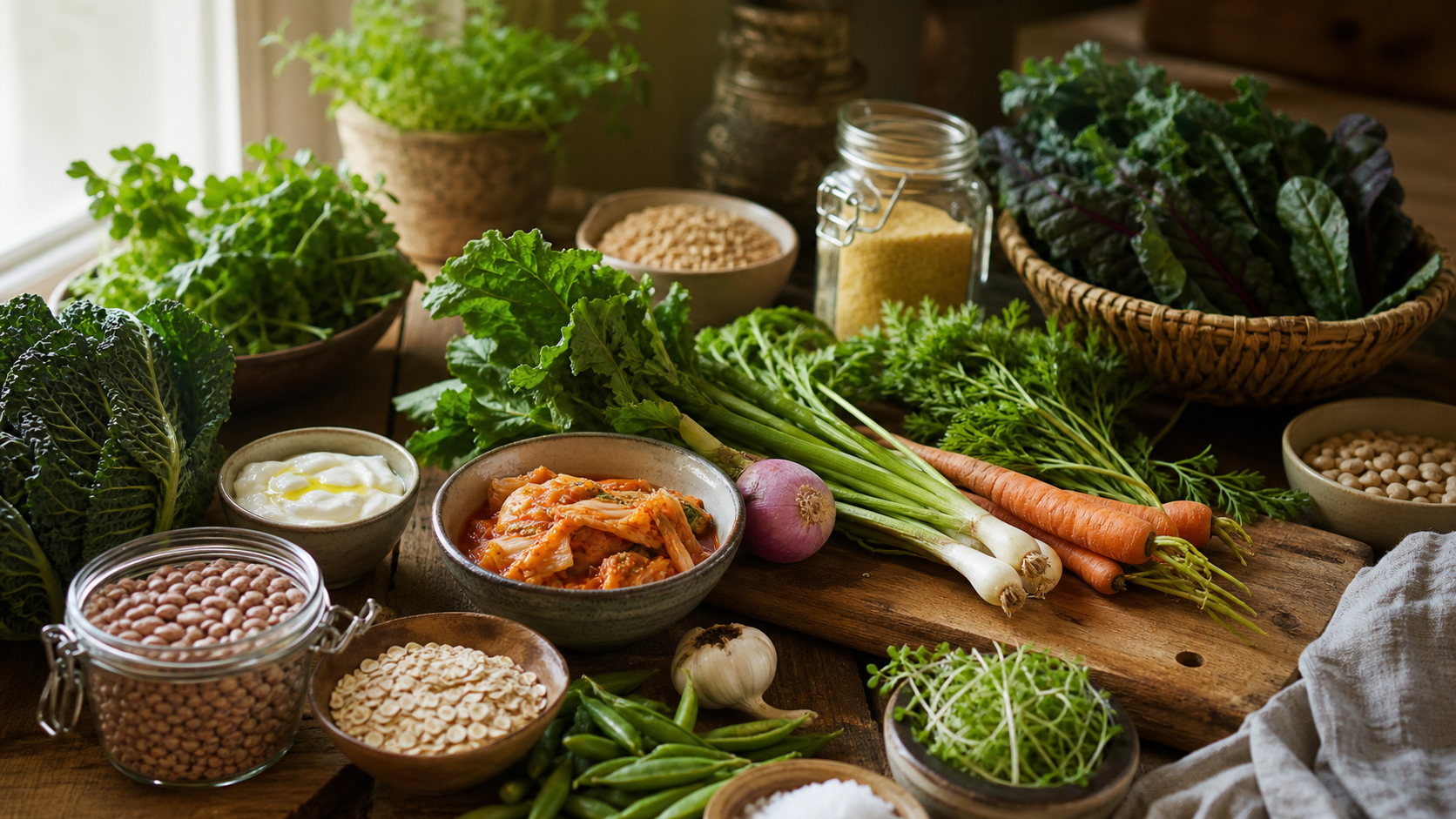
Dietary fiber is the primary fuel for beneficial gut bacteria. Aim for 30+ different plant foods per week — not just quantity, but diversity. Different bacterial species ferment different types of fiber, so variety is essential for rebuilding microbial richness. Prioritize: legumes (lentils, chickpeas, black beans), whole grains (oats, quinoa, barley), vegetables (especially prebiotic-rich onions, garlic, leeks, asparagus, Jerusalem artichokes), and fruits with intact fiber (berries, apples, pears).
3. Introduce Fermented Foods Daily
Fermented foods — yogurt with live cultures, kefir, kimchi, sauerkraut, miso, tempeh — directly introduce beneficial bacteria into the gut and have been shown in clinical trials to increase microbial diversity more effectively than high-fiber diets alone. A 2021 Stanford study found that a diet high in fermented foods increased microbiome diversity and decreased inflammatory markers over a 10-week period.
4. Support Akkermansia and Faecalibacterium
These keystone species thrive on specific substrates. Akkermansia muciniphila is supported by polyphenol-rich foods (pomegranate, cranberry, grape, green tea) and prebiotic fibers. Faecalibacterium prausnitzii is supported by butyrate-producing substrates including resistant starch (cooked and cooled potatoes, green bananas, legumes) and pectin-rich foods (apples, citrus peel).
5. Reduce Inflammatory Inputs
Beyond removing UPFs, reduce other gut-disrupting inputs: chronic stress (which increases intestinal permeability through cortisol-mediated pathways), unnecessary antibiotic use, and excessive alcohol consumption. Each of these compounds the damage that UPFs initiate.
6. Consider Targeted Probiotic Support
While whole-food sources are primary, specific probiotic strains have demonstrated clinical benefit for gut barrier repair and microbiome restoration. Lactobacillus rhamnosus, Bifidobacterium longum, and Lactobacillus helveticus have shown promise in reducing intestinal permeability and supporting the gut-brain axis. Work with a qualified practitioner to identify strains appropriate for your specific situation.
What Scripture Says About Nourishing the Body
"So whether you eat or drink or whatever you do, do it all for the glory of God." — 1 Corinthians 10:31
The biblical vision of the body is not incidental — it is sacred. We are called to steward the physical form we have been given with intentionality and wisdom. The food choices we make daily are not merely nutritional decisions; they are acts of stewardship over the temple of the Holy Spirit. When we understand that ultra-processed foods are actively dismantling the biological systems God designed to sustain us, the call to return to whole, created foods takes on a deeper dimension.
"He makes grass grow for the cattle, and plants for people to cultivate — bringing forth food from the earth." — Psalm 104:14
The foods that heal the gut are, almost without exception, the foods that grow from the earth in their created form: vegetables, fruits, legumes, whole grains, herbs, and fermented foods. The further we move from created food toward industrially engineered food, the further we move from the biological design that sustains human flourishing.
At Genesis World Health, we hold that "Ancient Wisdom. Modern Science. Divine Health." is not a slogan — it is a framework for living. The ancient wisdom of whole-food nourishment, now confirmed by modern microbiome science, points toward the same truth: real food, in its created form, is medicine for the gut and the whole person.
The GWH AI Agent Council integrates perspectives from our Nutrition specialist, Gut Health agent, and Functional Medicine advisor to provide personalized health insights on dietary approaches that support microbiome restoration. Our Deep Dive Sessions allow you to explore gut health in depth with a single specialist agent for focused, intensive guidance. Visit our Learn page for additional resources on nutrition and integrative health, and explore your Health Assessment to understand how your current dietary patterns may be affecting your whole-person health. Learn more about our Foundational principles that guide every recommendation we make.
Ready to Rebuild Your Gut Health From the Inside Out?
The GWH AI Agent Council brings together our Nutrition specialist, Gut Health advisor, and Functional Medicine agent to deliver personalized health insights on microbiome restoration, whole-food nutrition, and root-cause gut healing — all grounded in the principles of Ancient Wisdom. Modern Science. Divine Health. Start with your Health Assessment to receive insights tailored to your unique biology, or explore Deep Dive Sessions for focused one-on-one guidance with our Nutrition specialist.
Medical Disclaimer: As always, we encourage you to work with qualified healthcare providers — including registered dietitians, gastroenterologists, functional medicine physicians, and your primary care provider — when making significant changes to your gut microbiome and nutrition choices. Genesis World Health is an educational platform, not a substitute for professional medical care. Our role is to equip you with knowledge, insight, and the integrative perspective you need to have more informed conversations with your healthcare team.
Sources & References
- BBC Future: How Ultra-Processed Foods Influence Our Gut Microbiome (2026)
- Frontiers in Public Health: Ultra-Processed Foods, Additives, and Gut Microbiome Disruption (2026)
- Medscape: Ultra-Processed Foods and the Gut Microbiome (2026)
- PubMed: Dietary Patterns, Gut Microbiome Diversity, and Chronic Disease Risk
- MDPI Nutrients: NLRP3 Inflammasome Activation, Leaky Gut, and Ultra-Processed Food Consumption
- Springer: NOVA Classification, UPFs, and Cardiometabolic Risk — A 2026 Review
- WCHSB Insights: The Gut-Brain Axis Revolution — How Your Microbiome Shapes Your Mind (2026)