Urolithin A and Mitophagy: The Postbiotic That Cleans Your Cells and God's Design for Renewal
Every cell in your body contains hundreds of mitochondria — the tiny energy-generating structures that power everything from your heartbeat to your thoughts. But mitochondria age. They accumulate damage. And when too many dysfunctional mitochondria pile up, the consequences ripple outward: fatigue, inflammation, accelerated aging, and declining muscle function.
God, in His extraordinary design, built a solution directly into your cells. It's called mitophagy — a selective cellular recycling process that identifies damaged mitochondria, wraps them up, and clears them away so healthy ones can take their place. And a compound called Urolithin A, produced when your gut microbiome processes certain plant foods, appears to be one of the most potent natural activators of this process.
The science is genuinely exciting — and it deserves to be presented honestly. Here's what the human evidence actually shows, what remains preliminary, and how this emerging field connects to a biblical vision of renewal and restoration.
What Is Urolithin A — and Where Does It Come From?
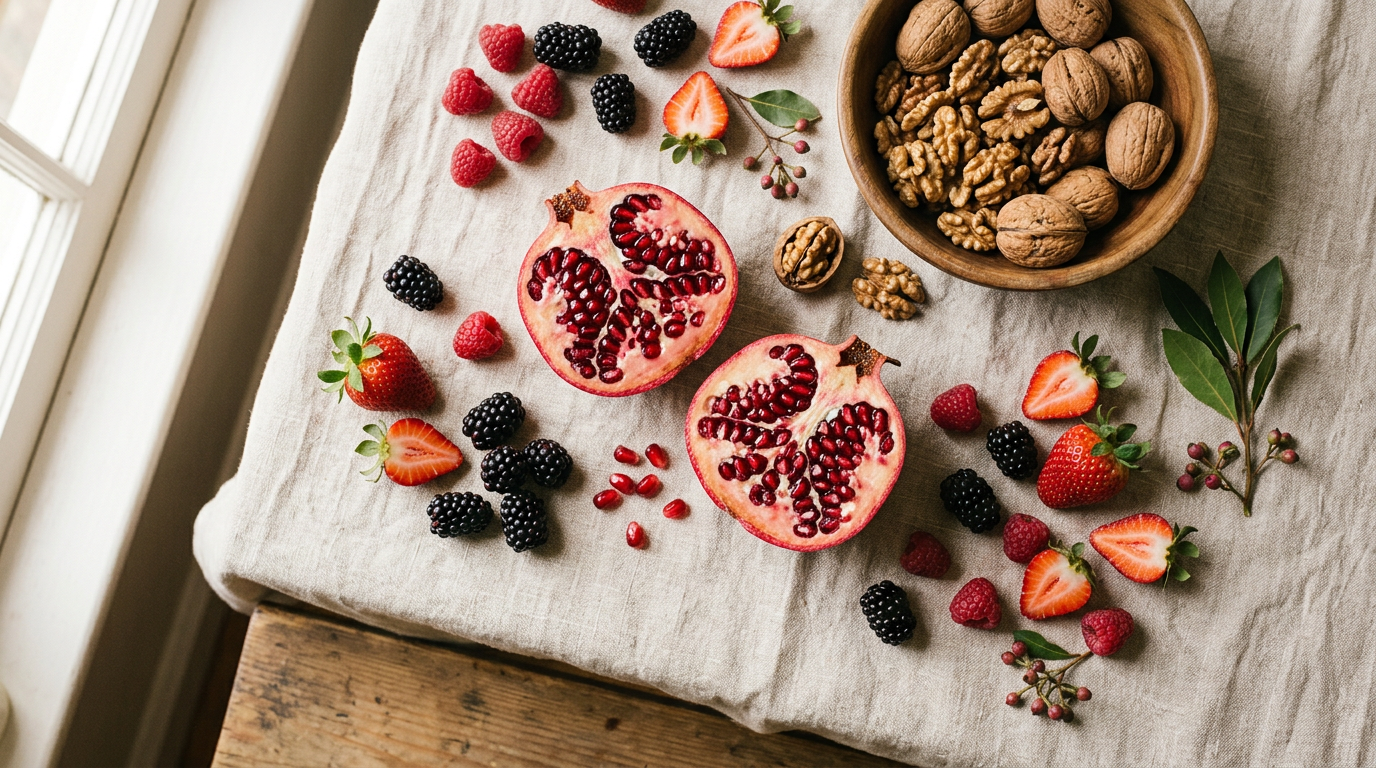
Urolithin A is not a nutrient you eat directly. It is a postbiotic — a compound your gut microbiome produces when it processes certain plant compounds called ellagitannins, found in pomegranates, walnuts, raspberries, strawberries, blackberries, and cranberries.
Here's the pathway: ellagitannins in these foods are broken down into ellagic acid in the gut. Specific gut bacteria then transform ellagic acid through a multi-step conversion — ring cleavage, decarboxylation, dehydroxylation — ultimately producing urolithins, including Urolithin A.
This means eating a pomegranate does not guarantee a predictable amount of Urolithin A in your bloodstream. The food supplies the raw material; your microbiome does the work. And not everyone's microbiome is equally equipped for this conversion.
Why Your Microbiome Matters for Urolithin A Production
Researchers have identified three distinct urolithin metabotypes — patterns of conversion that vary by individual gut microbial composition:
- UM-A: Produces Urolithin A as the primary end product — the most favorable conversion pattern
- UM-B: Produces Urolithin A alongside isourolithin A and/or Urolithin B — partial conversion
- UM-0: Produces little to no detectable urolithins — the conversion pathway is largely absent
Two people can eat the same pomegranate and produce dramatically different amounts of Urolithin A. This is one reason clinical trials have used direct Urolithin A supplementation — it bypasses the microbiome-dependent conversion step and delivers the compound more reliably.
This is also why gut health is foundational to so much of integrative medicine. A diverse, well-nourished microbiome doesn't just support digestion — it determines which beneficial compounds your body can actually produce from the foods you eat. Tools like Genesis World Health's AI Nutrition Specialist can help you build a dietary protocol that supports both ellagitannin intake and the microbial diversity needed to convert those compounds effectively.
The Science of Mitophagy: God's Cellular Renewal System
To understand why Urolithin A matters, you need to understand mitophagy — and it's worth taking a moment to appreciate just how remarkable this system is.
Mitochondria are not static structures. They constantly divide, fuse, and are replaced. But as we age, damaged mitochondria accumulate faster than they can be cleared. These dysfunctional mitochondria don't just stop producing energy efficiently — they actively generate reactive oxygen species (ROS), trigger inflammation, and contribute to cellular aging.
Mitophagy is the cell's quality-control response. The process works roughly like this:
- Damaged mitochondria are flagged: Proteins like PINK1 and Parkin mark impaired mitochondria for removal
- The autophagic machinery is activated: Signaling networks involving AMPK (an energy sensor), mTOR (a growth regulator), and ULK1 (an autophagy initiator) coordinate the response
- The mitochondrion is enclosed and degraded: A membrane wraps around the damaged organelle, which is then delivered to the lysosome for breakdown and recycling
- Cellular resources are reclaimed: The building blocks are reused to build new, healthy mitochondria
Experimental research suggests Urolithin A activates this process — stimulating AMPK-related signaling, reducing mTOR activity, and supporting ULK1-dependent autophagy. The mechanism is not a single linear switch; it's a regulated network that may operate differently across tissues and biological contexts. But the signal is consistent enough to have attracted serious scientific attention.
"Therefore, if anyone is in Christ, he is a new creation. The old has passed away; behold, the new has come." — 2 Corinthians 5:17
There is something deeply resonant about mitophagy when read alongside this verse. God designed the body with a built-in system for clearing away what is damaged and making room for renewal. The spiritual reality Paul describes — transformation, the old giving way to the new — finds a quiet echo in the cellular architecture of the body He created. We need not force Scripture into scientific language to appreciate the harmony.
What the Human Clinical Trials Actually Show
Two randomized, placebo-controlled trials published in 2022 provide the clearest human evidence for Urolithin A. Their results are genuinely encouraging — and worth understanding accurately, without overstating what was found.
Trial 1: Older Adults (Ages 65–90)
A double-blind trial randomized 66 adults aged 65–90 to receive 1,000 mg of Urolithin A daily or placebo for four months. The primary endpoints — six-minute walk distance and maximal ATP production in hand skeletal muscle — did not improve significantly compared with placebo.
However, secondary findings were more favorable. At two months, participants receiving Urolithin A completed more repeated muscle contractions before fatigue in both hand and leg tests. Plasma measurements showed decreases in acylcarnitines, ceramides, and C-reactive protein — biomarkers associated with mitochondrial fat metabolism and inflammation.
Trial 2: Middle-Aged Adults (Ages 40–64)
A second trial enrolled 88 untrained, overweight adults aged 40–64, receiving placebo, 500 mg, or 1,000 mg of Urolithin A daily for four months. The trial reported approximately 12% improvement in leg muscle strength, along with favorable changes in six-minute walking performance, peak oxygen consumption, plasma acylcarnitines, C-reactive protein, and muscle molecular signatures related to mitochondrial metabolism.
The primary endpoint — peak power output — did not improve significantly. Favorable secondary findings are meaningful, but they should not be presented as comprehensive proof of improved exercise performance.
The honest summary: Urolithin A shows a promising signal for muscle endurance and selected biomarkers. The evidence is preliminary, not definitive. Primary endpoints were missed in both trials. Independent replication is needed.
Food Sources vs. Direct Supplementation
Given the microbiome-dependent conversion pathway, a practical question arises: should you focus on ellagitannin-rich foods, or consider direct Urolithin A supplementation?
The answer depends on your goals and your microbiome's conversion capacity:
- Ellagitannin-rich foods (pomegranate, walnuts, raspberries, strawberries, blackberries, cranberries) provide the precursor compounds along with fiber, polyphenols, vitamins, and minerals — a whole-food matrix that supports overall health regardless of your metabotype
- Direct Urolithin A supplementation bypasses the conversion step and delivers more standardized exposure — the doses studied in trials were 500–1,000 mg daily for four months, with good tolerability reported
- Supporting your microbiome through dietary diversity, fermented foods, and prebiotic fiber may improve your natural conversion capacity over time
Neither approach is a substitute for a health-supporting diet. And neither has been proved to treat disease. Anyone considering supplementation — particularly those with existing health conditions or taking medications — should discuss it with a qualified clinician first.
Genesis World Health's Personalized Insights can help you integrate evidence-based nutritional strategies — including ellagitannin-rich foods and gut-supportive protocols — into a comprehensive approach tailored to your unique health profile and goals.
What About Osteoarthritis and the PROMETHEUS Trial?
You may have seen claims about Urolithin A and osteoarthritis, or references to the "PROMETHEUS trial." Both deserve careful clarification.
The frequently cited osteoarthritis research — published in Aging Cell in 2022 — studied Urolithin A's effects on human cartilage cells in the laboratory and in a mouse model of osteoarthritis. The results were promising: improved mitochondrial respiration, reduced cartilage degeneration, and decreased inflammation in the animal model. But this was not a human clinical trial. As of September 2026, no published human trial has demonstrated that Urolithin A prevents or treats osteoarthritis in people.
PROMETHEUS — a precision geriatric medicine protocol published in GeroScience in July 2026 — is an eight-week feasibility study involving 20 participants. It tests a multimodal healthy-aging program that may include Urolithin A alongside dietary guidance, exercise, sleep support, and other supplements. It is a published protocol, not a completed efficacy trial. Results have not yet been reported.
This is not a reason to dismiss the science — it's a reason to follow it with appropriate expectation. The preclinical signals are genuinely interesting. Human trials are the next step.
A Whole-Person Approach to Mitochondrial Health
Urolithin A is one piece of a much larger picture. Mitochondrial health — and by extension, cellular renewal — is supported by a constellation of lifestyle factors that work synergistically:
- Exercise: Both resistance training and aerobic exercise (particularly Zone 2 training) are among the most potent known stimulators of mitochondrial biogenesis and quality control
- Sleep: Deep sleep is when cellular repair processes — including mitophagy — are most active; chronic sleep deprivation impairs mitochondrial function
- Anti-inflammatory nutrition: A diet rich in polyphenols, omega-3 fatty acids, and fiber supports the gut microbiome and reduces the oxidative burden on mitochondria
- Stress reduction: Chronic psychological stress elevates cortisol and generates oxidative stress that accelerates mitochondrial damage
- Fasting and time-restricted eating: Periods of caloric restriction activate autophagy pathways, including mitophagy
For those interested in exploring the emerging science of cellular renewal — including peptide therapies, mitochondrial support protocols, and advanced longevity strategies — Genesis World Health offers VIP-exclusive agents covering regenerative medicine and emerging cellular health research, providing educational perspectives on the frontier of healthy aging.
Stewardship of the Body God Designed
The science of mitophagy is, at its core, a story about the body's extraordinary capacity for self-renewal — a capacity God built into every cell. The fact that your body has a system for identifying what is damaged, clearing it away, and making room for what is new is not a coincidence. It is design.
"Do you not know that your bodies are temples of the Holy Spirit, who is in you, whom you have received from God? You are not your own; you were bought at a price. Therefore honor God with your bodies." — 1 Corinthians 6:19-20
Honoring God with our bodies means taking seriously the stewardship of the physical form He gave us — not out of vanity or fear, but out of gratitude and purpose. Supporting mitochondrial health through wise nutrition, consistent movement, restorative sleep, and stress management is an act of stewardship. Urolithin A, when the evidence supports its use, may be one educational tool in that stewardship conversation.
But the deepest renewal — the transformation that matters most — is not cellular. It is the new creation Paul describes in 2 Corinthians 5:17. The body's mitophagy is a shadow of something far greater: the God who makes all things new.
Ready to Support Your Cellular Renewal Journey?
Genesis World Health's AI Nutrition Specialist can help you build a personalized dietary protocol rich in ellagitannin-containing whole foods, while our Personalized Insights integrate nutrition, movement, and sleep strategies that support mitochondrial health from every angle. For those exploring the frontier of longevity science, our VIP-exclusive agents cover regenerative medicine and emerging cellular health research.
A Personal Note from Genesis World Health
The information shared in this article is for educational purposes and reflects our commitment to integrating faith, science, and whole-person wellness. It is not a substitute for professional medical advice, diagnosis, or treatment. Every person's health journey is unique — fearfully and wonderfully made — and what works for one may not be right for another.
We encourage you to consult with integrative medicine physicians, registered dietitians, longevity specialists, and your primary care provider when making significant changes to your supplement regimen and cellular health approach. Our prayer is that this knowledge empowers you to make informed, faith-guided decisions for the body God has entrusted to you.
Sources & References
- Andreux PA, et al. "Effect of Urolithin A Supplementation on Muscle Endurance and Mitochondrial Health in Older Adults." JAMA Network Open. 2022. PubMed PMID: 35050355
- Liu S, et al. "Urolithin A Improves Muscle Strength, Exercise Performance, and Biomarkers of Mitochondrial Health in a Randomized Trial in Middle-Aged Adults." Cell Reports Medicine. 2022. PubMed PMID: 35584623
- D'Amico D, et al. "Urolithin A Improves Mitochondrial Health, Reduces Cartilage Degeneration, and Alleviates Pain in Osteoarthritis." Aging Cell. 2022;21(8). DOI: 10.1111/acel.13662
- PROMETHEUS Protocol. "PRecision gerOMedicinE: Tailored Healthy agEing With Lifestyle, sUpplements and drugS." GeroScience. Published July 3, 2026. DOI: 10.1007/s11357-026-02394-6
- Ryu D, et al. "Urolithin A induces mitophagy and prolongs lifespan in C. elegans and increases muscle function in rodents." Nature Medicine. 2016;22(8):879-888. DOI: 10.1038/nm.4132
- Singh A, et al. "Urolithin A: A Gut Metabolite with Emerging Roles in Mitochondrial Health and Aging." Ageing Research Reviews. 2022. PubMed PMID: 35577277