Four Minutes a Day: The 2026 Penn State Study That Proves Small Effort Honors God's Design for Aging Well
Four Minutes That Could Change Everything
For decades, the message about exercise and aging has been delivered with the best of intentions but the worst possible effect: older adults were told they needed 150 minutes of moderate activity per week, structured gym routines, and specialized equipment to stay healthy. For the millions of Americans over 65 who are already sedentary, already managing joint pain, already overwhelmed by the complexity of modern fitness culture, that message did not inspire action. It inspired guilt. And guilt rarely produces lasting change.
A 2026 study from Penn State College of Medicine has quietly rewritten that story. Researchers found that just four minutes of daily strength training, performed at home with no gym membership and minimal equipment, was linked to statistically significant improvements in balance, leg strength, and functional mobility in older adults with mobility limitations. The study, published in PLOS One, is not a wellness trend piece. It is a randomized controlled trial with 97 participants, an 81 percent adherence rate, and outcomes measured on tests that researchers associate with fall risk and the ability to live independently.
For those who believe the body is a gift from God, this research carries a particular kind of weight. The question was never whether older adults could improve their physical function. The question was whether the barrier to entry could be lowered enough that they would actually begin. This study suggests that four minutes a day may be a realistic place to start.
The Short Answer
Can four minutes of daily exercise help older adults? In a 12-week randomized trial of 97 inactive adults (average age 74), a four-minute daily home routine of push-ups, chair stands, band rows, and step-ups was associated with more chair stands in 30 seconds, a faster sit-to-stand time, and longer one-legged balance compared with no exercise. These tests are linked to fall risk and independence. The study did not count falls directly, but it suggests a small, consistent effort is a realistic starting point.
What the FAST-2 Study Actually Found
The FAST-2 program, which stands for Functional Activity Strength Training, was designed specifically for inactive older adults. The 97 participants in the trial had an average age of 74 and reported exercising an average of only 18 minutes per week before the study began. These were not athletes looking to optimize performance. These were ordinary older adults who had largely stopped moving.
The daily routine consisted of four exercises, each performed for 30 seconds followed by 30 seconds of rest:
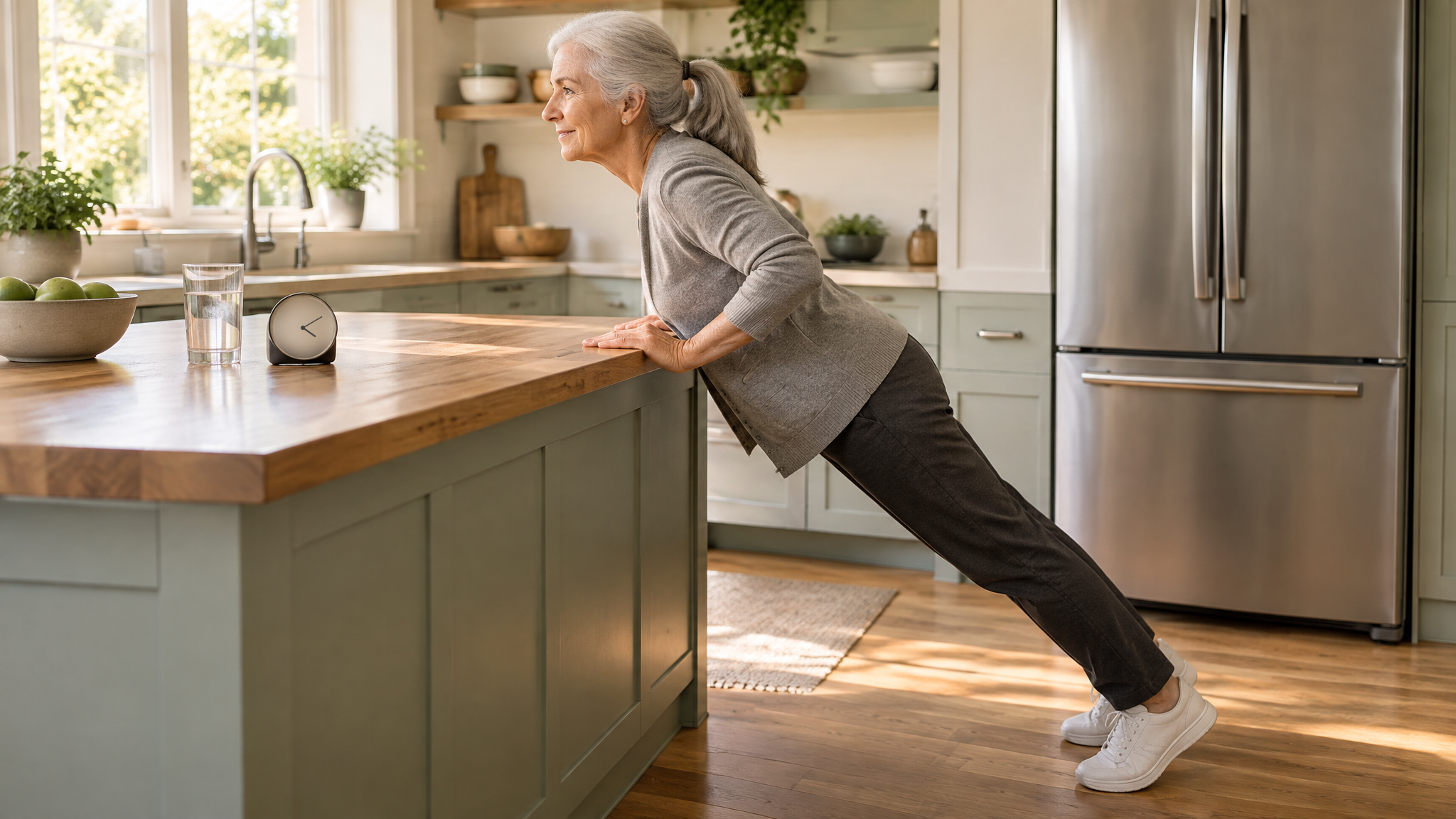
- Push-ups (modified against a wall or countertop for those who needed it)
- Chair stands (rising from a seated position, targeting leg strength)
- Two-arm rows (using elastic resistance bands for upper body strength)
- Stair stepping (using an adjustable-height platform for leg mobility)
After 12 weeks, the differences were notable. Participants in the FAST-2 group completed an average of 4.2 additional chair stands in a 30-second window compared to the control group. Their one-legged balance time increased by 3.6 seconds. Their time to complete the five-times sit-to-stand test dropped by 2.3 seconds. These are not vanity metrics. Senior researcher Dr. Christopher Sciamanna of Penn State College of Medicine noted that these specific indicators are associated with an individual's likelihood of falling, their ability to live independently, and their potential future need for nursing home care.
The 81 percent adherence rate may be the most important finding of all. Most exercise interventions for older adults struggle with dropout. The FAST-2 program may have succeeded because it removed the primary barriers: time, complexity, and the need for a gym. When the ask is small enough, people say yes.
Why Functional Strength Matters More Than Fitness
There is an important distinction between fitness and functional strength, and it is one that the FAST-2 study makes beautifully clear. Fitness, as it is commonly understood, is about cardiovascular capacity, body composition, and athletic performance. Functional strength is about the ability to rise from a chair without assistance, to carry groceries without losing balance, to climb a flight of stairs without gripping the railing in fear.
For older adults, functional strength is the difference between independence and dependence. Falls are the leading cause of injury-related death among adults over 65 in the United States, and declining lower-body strength and impaired balance are closely associated with fall risk. A 2019 Cochrane review of community-dwelling older adults found that exercise programs, particularly those combining balance and functional training, were associated with fewer falls. (For a deeper look at age-related muscle loss, see our article on sarcopenia and integrative resistance training.)
The FAST-2 exercises were chosen precisely because they mirror the movements of daily life. A chair stand is not an abstract gym exercise. It is the motion of getting up from the dinner table, rising from the toilet, or standing up from the couch. When that movement becomes difficult, independence begins to erode. When it becomes impossible, the consequences are profound.
The Exercise and Movement agent, one of the Digital Health Agents in the Genesis Council, shares educational insights that echo this distinction: the goal of movement in later life is not to look a certain way. It is to preserve the capacity to live fully, to serve others, and to remain present in the lives of the people you love.
The Science of Muscle Adaptation at Any Age
One of the most persistent myths about aging is that muscle loss is inevitable and irreversible. The science tells a more hopeful story. While sarcopenia, the age-related loss of muscle mass and strength, does accelerate after age 50, the muscle tissue of older adults retains a remarkable capacity to respond to resistance training. A landmark 1994 study published in the New England Journal of Medicine demonstrated that frail nursing home residents in their 80s and 90s roughly doubled their leg strength in about ten weeks of resistance training. More recent research suggests that the fundamental mechanisms of muscle protein synthesis remain intact in older adults, even if they require slightly more stimulus to activate.
The FAST-2 study adds to this body of evidence by suggesting that the stimulus may not need to be large. Four minutes of daily resistance exercise, performed consistently, was associated with meaningful improvements in previously sedentary older adults. The key word is consistency. The body responds to repeated, regular demands. A four-minute routine performed every day for 12 weeks represents 84 training sessions. That cumulative stimulus, modest as it appears on any given day, was linked to real, measurable change. (Learn more in The Science of Strength.)
This is also why adherence matters so much. A 60-minute workout performed twice a month is unlikely to offer what a four-minute workout performed daily. The FAST-2 program succeeded not because it was intense, but because it was sustainable. And sustainability, in the context of health behavior, matters enormously.
Integrative Support for Aging Well
Physical exercise does not operate in isolation. The research on healthy aging consistently points to a cluster of interconnected factors: movement, nutrition, sleep, stress management, and social connection. Addressing one without attending to the others may produce incomplete results.
From a nutritional standpoint, adequate protein intake is essential for muscle protein synthesis in older adults. The PROT-AGE Study Group, writing in the Journal of the American Medical Directors Association, recommended that healthy older adults consume 1.0 to 1.2 grams of protein per kilogram of body weight per day, and at least 1.2 grams for those who are exercising. Leucine-rich protein sources, including eggs, fish, legumes, and dairy, are associated with stronger muscle protein synthesis.
Sleep is equally critical. Growth hormone, which plays a central role in muscle repair and recovery, is released primarily during deep sleep. Chronic sleep deprivation is linked to impaired muscle recovery and higher cortisol levels, which may work against the benefits of exercise. The Sleep and Circadian agent, available in the VIP tier, shares educational insights on sleep as a foundation for physical recovery and longevity.
Low vitamin D status is common in older adults and is associated with reduced muscle strength. A 2014 meta-analysis of randomized trials in the Journal of Clinical Endocrinology & Metabolism found a small positive effect of vitamin D supplementation on muscle strength, with larger effects in people who started out deficient. (See our article on vitamin D and God's design.)
The Nutraceuticals agent shares educational information on nutrients researched for muscle and physical function, from protein to micronutrients, so members can explore the evidence for themselves.
Stewardship of the Body God Entrusted to You
The Apostle Paul wrote to the church at Corinth with a directness that has not lost its edge across two millennia:
"Do you not know that your bodies are temples of the Holy Spirit, who is in you, whom you have received from God? You are not your own; you were bought at a price. Therefore honor God with your bodies." — 1 Corinthians 6:19-20
This is not a passage about fitness culture. It is a passage about stewardship. The body is not ours to neglect or to abuse. It is a gift, entrusted to us for a purpose, and that purpose extends across every decade of life. The call to honor God with our bodies does not expire at 65 or 70 or 80. If anything, it deepens.
There is a particular kind of faithfulness required in later life, one that resists the cultural narrative that aging is simply decline to be endured. Scripture offers a different vision. Caleb, at 85 years old, stood before Joshua and declared: "I am still as strong today as the day Moses sent me out; I'm just as vigorous to go out to battle now as I was then." (Joshua 14:11). The Psalmist wrote of the righteous who "still bear fruit in old age, who stay fresh and green." (Psalm 92:14). These are not metaphors for passive survival. They are images of active, purposeful vitality.
Four minutes a day is not a heroic act. But it is a faithful one. It is the daily decision to steward what God has given, to resist the slow surrender of capacity that comes from inaction, and to remain present and capable in the lives of the people who need you.
The FAST-2 study is, in this sense, more than a research finding. It is a practical answer to a spiritual question: what does faithful stewardship of an aging body look like when time is short, energy is limited, and the barriers to traditional exercise feel insurmountable? It looks like four minutes. Every day. Consistently.
Practical Steps to Begin
The FAST-2 program requires no gym membership, no specialized equipment beyond a resistance band and a sturdy chair, and no prior fitness experience. The four exercises can be performed in any room of the house. Here is how to begin:
Week 1-2: Perform each exercise in its most modified form. Push-ups against the wall. Chair stands with hands on the armrests. Rows with a light resistance band. Step-ups on the lowest setting. Focus on completing the full four minutes without stopping.
Week 3-6: Progress gradually. Move push-ups to a countertop. Attempt chair stands without using your hands. Increase resistance band tension. Raise the step height by one level.
Week 7-12: Continue progressing toward standard versions of each exercise. The goal is not perfection but consistent forward movement. If a day is missed, simply resume the next day without guilt or self-recrimination.
The most important step is the first one. Not the perfect one. Not the optimal one. The first one.
Frequently Asked Questions
What exercises are in the four-minute FAST-2 routine?
Four moves, each done for 30 seconds with 30 seconds of rest: push-ups against a wall or countertop, chair stands, two-arm rows with an elastic band, and stepping on a low adjustable platform.
How long did it take participants to see changes?
The study measured results after 12 weeks of daily practice. Participants completed the routine on about 81 percent of study days.
Do I need special equipment?
Very little. A sturdy chair, a wall or countertop, a resistance band, and a low step are enough. No gym membership is required.
Did the study show fewer falls?
The study did not count falls directly. It measured strength and balance tests that researchers associate with fall risk and independence, and those scores improved compared with the control group.
Is four minutes a day enough exercise on its own?
The study suggests it is a meaningful starting point for inactive older adults, not a complete fitness plan. Many people use it as a foundation and add walking or other activity over time. Our article on the body as a temple explores movement as stewardship.
What does Scripture say about strength in later life?
Caleb declared at 85, "I am still as strong today as the day Moses sent me out" (Joshua 14:11), and Psalm 92:14 describes the righteous who "still bear fruit in old age." Scripture pictures later life as a season of purpose, not only decline.
Your Body Was Designed to Move at Every Age
Genesis World Health's Digital Health Agents in Exercise and Movement, Nutraceuticals, Sleep and Circadian health, and more share educational insights for whole-person wellness at every stage of life. Whether you are 35 or 75, the journey toward faithful stewardship of your body starts with one small, consistent step.
Genesis World Health's Digital Health Agents are digital tools, not human practitioners. They share educational insights only, and no person reviews your information.
A Personal Note from Genesis World Health
The information shared in this article is for educational purposes and reflects our commitment to integrating faith, science, and whole-person wellness. It is not a substitute for professional medical advice, diagnosis, or treatment. Every person's health journey is unique — fearfully and wonderfully made — and what works for one may not be right for another.
We encourage you to consult with geriatric medicine specialists, physical therapists, exercise physiologists, and your primary care provider when making significant changes to your physical activity and strength training approach. Our prayer is that this knowledge empowers you to make informed, faith-guided decisions for the body God has entrusted to you.
Sources & References
- Dandekar, et al. (Sciamanna CN, senior author). "Brief daily functional strength training to improve functional performance in older adults with mobility disability: A randomized trial." PLOS One. March 2026. https://journals.plos.org/plosone/article?id=10.1371/journal.pone.0336748
- Penn State News. "Four-minute daily workout improves strength, balance in older adults." 2026. https://www.psu.edu/news/research/story/four-minute-daily-workout-improves-strength-balance-older-adults
- Penn State University. "Four-minute daily workout improves strength, balance in older adults." ScienceDaily. October 2026. https://www.sciencedaily.com/releases/2026/10/261020085025.htm
- Sherrington C, et al. "Exercise for preventing falls in older people living in the community." Cochrane Database of Systematic Reviews. 2019. https://doi.org/10.1002/14651858.CD012424.pub2
- Bauer J, et al. "Evidence-Based Recommendations for Optimal Dietary Protein Intake in Older People: A Position Paper From the PROT-AGE Study Group." Journal of the American Medical Directors Association. 2013;14(8):542-559. https://doi.org/10.1016/j.jamda.2013.05.021
- Beaudart C, et al. "The Effects of Vitamin D on Skeletal Muscle Strength, Muscle Mass, and Muscle Power: A Systematic Review and Meta-Analysis of Randomized Controlled Trials." Journal of Clinical Endocrinology & Metabolism. 2014;99(11):4336-4345. https://doi.org/10.1210/jc.2014-1742
- Fiatarone MA, et al. "Exercise training and nutritional supplementation for physical frailty in very elderly people." New England Journal of Medicine. 1994. https://pubmed.ncbi.nlm.nih.gov/8190152/